I would imagine Planned Parenthood fears names

I’d been composing this post in my head all morning, and when I sat down just now to write it, I logged into Twitter to access the link to an article I wanted to reference here, and saw that the fifth Planned Parenthood video has just been released (warning: graphic). I briefly skimmed the beginning of the article, stopping before I got to any graphic visuals, and yes, it’s truly awful, and I’m glad to join in the outrage in the way that a name blog can.

This was the article I logged into Twitter to get, which I’d retweeted the other day: The Difference a Name Makes by Molly Oshatz at First Things. An excerpt:

It’s amazing the difference a name makes. On one day this past week, nearly a hundred endangered elephants were killed and around 3,000 abortions were performed in the United States alone, and we were unfazed—but the killing of Cecil the lion broke our hearts. He wasn’t just any random lion. He was Cecil. Mere lions (along with chickens, cows, lambs, and pigs) are killed, but Cecil was murdered. We love the lion that was named Cecil. We feel as though we knew him.”

I hadn’t given one thought to the idea that Cecil had made such huge headlines because he had a name (and all that a name implies) before reading this, but it makes sense. Knowing one’s name is what makes a person — or in this case, a lion — emerge from the nameless hoards as an individual. It’s like a sea of body-shaped gray-scale shades until names become known, and then faces emerge, detailed and clear and in color. It’s an individual marker for an individual, an entity separate from the crowd.

“The abortion industry knows very well the difference a name can make … “

This was certainly the reasoning behind this article posted at StudentsforLife.org, which I’d also referenced on my Instagram last week: Call Him Emmett. An excerpt:

The little boy in the most recent undercover Planned Parenthood videos from the Center for Medical Progress has been referred to as “Eleven Six”, meaning that he was aborted at 11 weeks 6 days gestation. His tiny body parts are easily identifiable in the horrific videos as they are sorted in order to be sold.

This baby deserves a name, deserves dignity that is rightly afforded him as a member of the human race … 

His name should be Emmett, after the boy of the same name who became the catalyst for the 1950s and 60s Civil Rights Movement.

Emmett Till was a 14-year-old black boy from Chicago who dared to speak to a white woman when he was visiting relatives in Mississippi. He was subsequently beaten with one eye gouged out, and then shot through the head before being tethered to a heavy gin and thrown in the river. His body was recovered three days later and returned to his mother in Chicago … 

Rosa Parks even said she was inspired by the boy: “I thought of Emmett Till and I just couldn’t go back.”

This baby boy in the Center for Medical Progress is the Emmett Till of the pro-life movement.”

I thought Emmett seemed most appropriate for this baby. It made me think of the web site 50 Million Names, a “grassroots campaign to collect names for the now-more-than 50,000,000 children aborted in our country.” As it says,

We ask Namers to register and then add names in a way that shows reverence for the lives of the aborted babies. Each name registration is accompanied by some concrete gesture made by the Namer in honor of this particular child.

Our hope is that these names will someday be read into state congressional records one by one, once each state’s million names are given. When all the names have been collected, perhaps the entire list could be read into the national congressional record.”

Because names are that important. How different it is to say, “These are the aborted babies: Daniel, Jayden, Marisa, Benjamin, Keisha, Trey, Moses, Ava, Chloe …” than to say, “Fifty million babies have been aborted.” (It’s actually closer to 60 million. God help us.) Even I, a lifelong ardently pro-life pro-lifer, get lulled into an almost settled unhappiness when faced with the abortion statistics (all numbers, of course) instead of the devastation and horror I should always have when presented with this information. But now, when I think of Emmett? I’m going to think of that one individual baby, and the gruesome specifics of his death, and the injustice and evil of it all.

Names have power. But more than that, being named=being loved and known and wanted, and that sense doesn’t come from nowhere. God tells us, “Before I formed you in the womb I knew you” (Jeremiah 1:5) and, as we’re reminded at the end of the First Things article,

“… everyone is loved and named, even those whose parents don’t want them and can’t bear to love them, and whose lives the rest of us don’t deem worth living. Even before each and every one of us emerges from the womb and gains official “baby” status, we are already known, named, and loved; as in Isaiah 43:1, God says to us, “I have called you by name, and you are mine””
Girl names turned surnames

I’ve written before about boy names that have “gone girl” but I’ve compiled a small list of names that started out as feminine first names that then became surnames, and I think (though I could be wrong) that last names as first names historically tended to be given to boys? Can anyone verify that? (I know the South has different traditions regarding last names as first names for girls.)

I’m sure there are much more than this, but these are just what I happened upon while reading Reaney & Wilson this morning:

Annas, Anness, Annis, Anniss are all from Old French Anés, which was “the vernacular form of Agnes”

Annatt, Annett, Annetts, Annott are from Ann-ot, which was a diminutive of Ann, which was a pet-form of Annes (Agnes)

Ebbetts, Ebbitt, Ebbutt may be from Ebbot or Ebbet, which were diminutives of Ebb for Ibb, which was a pet-name for Isabel

Emmatt, Emmet, Emmett, Emmitt, Emmott, Emmert, Emett, Hemett all from Emmot, which could be from a place in Lancashire, but also “Emmot was a very common pet-name for Emma”

Ibbelot, Iblot from Ibb-el-ot, a double diminutive of Ibb, which could be a pet form of Isabel (also of Ilbert)

Ibbott, Ibbett, Ibbitt, Hibbit, Hibbitt, Hibbott, Ibbs, Hibbs can all come from Ibb or Ibb-ot, which is a diminutive of Ibb

Ibell, Hibble, Hible from Ib-el, a diminutive of Ibb

Ibson means “son of Ibb”

Ibbelot, Iblot are from Ibb-el-ot, which is a double diminutive of Ibb

Libby, Lebby were surnames from pet names of Isabel

Libbet, Libbett from Libb-et, from Libb, which was a pet form of Isabel

The thing I love most about these is their possibility as fresh-seeming nicknames or variants of Agnes, Emma, Isabel, and Elizabeth for girls (I’ve actually heard of a woman named Elizabeth who goes by Libbett), and variants for honoring female relatives for boys (like, naming a boy Emmett after Grandma Emma or Hibbs after Grandma Elizabeth or Isabel). What do you all think?

Reading round-up (middle name edition)

I was asking you all about middle names (here and here and your comments were so helpful and interesting!) because I wanted to write about them for my July CatholicMom.com column — it turned out to be a much bigger animal than I expected! My column will be posted on Wednesday — I’ll post the link here when it’s up — and I’ll be interested to see what you all think.

In the meantime, I came across some really interesting articles while trying to do some “quick” research of what I thought was a fairly straightforward topic:

Why Do We Have Middle Names? which provides a brief intro to the history of middle names in America.

Despite the warning at the top of the page that “This article has multiple issues” I found the Wiki article on middle names to be helpful as well, and the list it provided of famous people who go by their middle names especially interesting.

Also fascinating was this one, about middle initials that don’t stand for anything, and middle initials/names that have been entirely made up: The Quick 10: People With Fake Middle Initials.

In Why Bother With a Middle Name? by the Name Lady, I liked this bit particularly:

In some cases, middle names can perform clear functions. Families with common surnames rely on them to help distinguish their children at school or on legal forms. Middle names can also serve religious roles, such as linking the child to a saint as a role model for a godly life.

For other families, the middle name is a chance to honor personal connections. Some use the middle name slot to pass on a family surname, or pay homage a relative or personal hero. Others use it to reflect their children’s cultural heritage. For instance, American families of Chinese ancestry may choose an English first name and a Chinese middle name for a child.

And then there’s simply style. A middle name can make the full composition sound elegant for formal occasions. It can be a place to play, to experiment with a more daring and unconventional choice than you’d choose for a first name, or send a kind of secret message to your child. And some parents just love names and don’t want to stop at only one!

In other words, middle names serve all of the many, many roles that names in general serve, except identification. If you don’t value any of those roles, you can skip the middle name altogether…but don’t expect your child to thank you for it. Necessary or not, middle names have become so standard in the United States that kids without them can feel slighted.”

The comments on this post provided some good insight as well.

I’m always super interested in personal experience, so I liked this from the Catholic Answers forums: Does your child not have a middle name?

This was not entirely on the topic I hoped for (only the first paragraph or so was about names), but I loved it anyway: What That Middle Initial In My Dad’s Name Could Mean. I can’t get it to load right now (?), but there was a fascinating bit about (if I remember correctly) the bishop’s dad’s middle initial being “H” but there being confusion over what it stood for. One document said Henry, another said Harry, and his baptismal certificate said Hieronymus, which is Latin for Jerome … so maybe his middle initial was actually J? Fascinating, and a lovely tribute to his dad.

I thought this was surprisingly well written for someone who’s not a name writer: What’s In a Name? It includes a list of “naming features that might cause confusion” given that “Most Americans have three names: given-middle-family (which are called “first-middle-last” ). This means most officials and and clerical information-takers in the United States expect clients, patients, and customers to follow this pattern. When internationals present their unique names, the Americans are flummoxed because there are standard boxes to fill in, but the names don’t cooperate. Additionally, sometimes American names can create problems.” He also provides a list of do’s and don’t’s regarding others’ names, which I thought was quite good.

This is for more of a chuckle at the question asked than for the information provided: Do Catholic people have middle names? I think the asker was totally genuine and unsure, but calling us “Catholic people” and wording the question as “do they have to go through confirmation or something to get one? I don’t think they have middle names on their birth certificates” suggested a somewhat benevolent kind of other-ness about us that’s not something I usually find being assigned to me. (I mean, I often [almost always?] feel different from those I interact with because of my faith [likely a lot of you too, right?], but not in the way this article made me feel — almost like we’re a curiosity.) The answers are fine, and the one about Ukrainian Catholic and Orthodox naming practices was quite interesting. (It would be great for the asker to stumble upon our little community here — she’d learn everything she’s ever wanted to know about Catholic naming practices! 😀 )

This was probably my favorite of all the articles I read: The power and peril of the middle name. It was both cheeky and informative, a really interesting read. It mentions the name “Gideon Oliver,” which I immediately fell in love with as an amazing combo (though I have zero knowledge of George Osborne, the Brit politician/current First Secretary of State who was named Gideon Oliver Osborne at birth, so perhaps it would be unwise to give a child his exact original first and middle names without researching what kind of man/politician he is? Just in case). (Nicknamey me also immediately went to the possibility of “Geo” as a nickname for “Gideon Oliver” … love it!) And whatever you think of our President, this quote attributed to him made me laugh out loud:

I got my first name from my father, and I got my middle name from someone who obviously didn’t think I’d ever run for president.”

(Barack Hussein Obama, in case you couldn’t remember his middle name.)

Finally, if any of you hold any sway with the SSA, can you please request that they start keeping track of middle names?? I think they’d be at least as revealing as first names, if not even more so, and likely a more diverse list as well.

This has been an interesting subject to research and learn more about this week! Please feel free to continue adding your stories/experiences, I love reading them all!

More about middles

You guys have been great with responses about middle names!! I have a couple more questions:

— I’ve seen a couple examples now where boys were given just a letter as a middle name … do you know any girls who were similarly named?

— I understand in the military (or at least in the past) if you have no middle name the middle name spot is filled with NMN — I imagine that could lead to some funny misunderstandings in civilian life — do any of you know more about that?

I’m finding all this fascinating! (I’ll post today’s giveaway a bit later.)

St. Anne giveaway #6, and some middle name questions

I just posted a pic of today’s holy card giveaway — “Prayer to St. Anne — To Obtain Some Special Favor.” I have five, so the first five people who email me at sanctanomina@gmail.com will get them!

And some questions for you all: I’m wondering about people who weren’t given a middle name at birth. Specifically:

— Do you wish you’d been given one, or are you happy without?

— If you took a different Confirmation name, did you start to use it as your middle name?

— If you’re a married woman who took your husband’s last name, did you find it easier/less complicated to just move your maiden name into the middle spot legally (if you chose to do so) than if you’d had a middle name there as well?

— Of the people you know who weren’t given a middle name at birth (including yourself), how many are men and how many are women?

If these questions don’t pertain to you, but you know people without middle names, please share their experience/opinion also, if you know it!

Happy Independence Day!! And a question

I know no one’s reading today, so I’ll probably reblog this later this week, but just in case someone’s looking for something namey to read on this great day and some questions of life-altering import to consider (ha!), here ya go. 🙂

We all have strong opinions regarding names, yes? We all have our tastes and styles, we like what we like. All of which is totally fine, since, as long as we’re not talking about Lucifer or Eva-Braun (hyphenated double first name thankyouverymuch), names are not a moral issue. We’re free to disagree! You can like John and you can like Hezekiah and you can like Kayden and none of it has a lick to do with your worth as a person or how much you love your child or whether you’re a good parent or not or your status before God.

I’ve found that the more conversations I have in which I find out why parents chose the name(s) they did for their child(ren), the more and more obvious it is to me that parents in general choose names for their little ones that they love. Names that really sing for them, that make them light up with joy that yes! This is the name for my child, my beloved.

Now I do think sometimes it’s a kindness to point out to parents trying to decide on a name for their unborn baby if there’s a glaring issue with a name. Like, if you knew parents were considering “Tiger” and you knew there was a chance they didn’t know about Tiger Woods as a celebrity personality, nor as a person with some negative associations due to unsavory information about his private life that was made public, I would think it important to find a quiet moment to gently point it out. Then, once it’s pointed out, you’ve done your job! No need to harp on.

Criticisms of a child’s name after he or she’s already been named? So uncool. So unkind.

I was thinking of all this because I received my very first negative comment!! Not here (as if! You all are so wonderful ❤ ) — over on my Nameberry post. In one few-sentence comment, (1) choosing names like the ones I’d written about was declared “tacky” and “chavvy” and (2) I’m pretty sure our country was one of the “certain countries” said to be “on the decline” intelligence-wise because of, I assume, some of the names American parents have chosen for their children. Ha!

I honestly truly do not care about disagreements in names. I do find it very sad that anyone would feel the need to throw parents and entire countries under the bus because of disagreements in names. I don’t have any interest in engaging in conversation with people who have such opinions, because I would imagine there’s some hurt there, and I don’t want to be the (even inadvertent) stick that pokes at a sore spot. Like when my kids are just totally beyond keeping it together, they often need extra softness from me. But it did make me want to ask you all:

What do you do when you know someone’s considering a name for their child that you think is unfortunate? If there’s a real issue with the name (like some obvious negative connotation), do you point it out? If it’s just a name that’s not your taste, do you tell them? Do you have real-life experiences like this, and how did you handle it? OR — have you been on the receiving end?

Have a wonderful 4th of July everyone!!

Land where my fathers died! Land of the pilgrims’ pride! From every mountainside, let freedom ring!”

New Nameberry post!

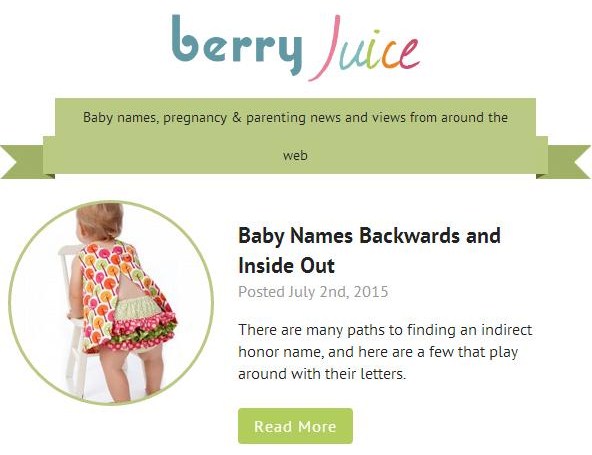
I have a new article up at Nameberry today!: Baby Names Backwards and Inside Out.

I’d love to hear your thoughts! Some of your comments on my original post about this topic were helpful in filling it out for Nameberry, and I included a couple in the article — thanks for always being so inspiring and knowledgeable!

(Today’s giveaway will go up in a little while. 🙂 )

nameberry_article-07.03.15

Catholic naming outside America

I read Jenny’s explanation of her kids’ names ages ago over at her blog Mama Needs Coffee, and this bit has stayed with me ever since:

“… while traveling in Italy (the first time) we chatted up a capuchin Franciscan from Poland in a restaurant in Assisi of all places, and as he bounced 7-month-old Joey on his knee, we proudly told him that his middle name was Kolbe “for Father Max.” The happy friar shot us a look of horror and asked in disbelief You took his family name?! So I guess the American trend of assuming surnames is not kosher the world over.”

I think I’m pretty knowledgeable about how to honor beloved saints within the landscape of the American baby naming scene, but I’d never really considered the idea that names that are okay here might be problematic elsewhere. I mean, certainly there’s a limit to how much parents should worry about such things, unless they’re planning to live abroad with their children, and being Catholic helps I think, because our saints come from every country. Biblical names also seem like a safe bet, since we all use the same Bible. But still I wonder …

Do any of you have any insights into what Catholic names to avoid if you’re worried about international opinions/sensibilities? Off the top of my head, certain categories of names that might cause issue are: surnames (as illustrated above), place names, and names traditionally given to one gender being used by the other. Do any of you have stories like Jenny’s?

Holy Spirit names

A reader asked me for ideas for names to honor the Holy Spirit — cool question, right? I’d never thought of names for the Holy Spirit before, but it’s a lovely thought. This is what I came up with:

— A “spirit” meaning, like Hugh/Hugo

— A “dove” meaning, like Colum/Columba, Jemima, Paloma, Jonah, or Dove itself. Or this interesting treat (from behindthename):

UXUE

Gender: Feminine

Usage: Basque

Meaning & History: From the Basque name of the Spanish town of Ujué where there is a church dedicated to the VirginMary. Its name is derived from Basque usoa “dove”.

Mother Mary and the Holy Spirit in one name! But Uxue? I don’t even know how to say it! Haha!

— One of the ways I once heard the Trinity explained are that the Father is the lover, the Son is the beloved, and the Holy Spirit is the loving that goes back and forth between them. I could see a “love” name going along with that — like Amanda, Amadeus (literally means “love of God”), Carys, Charity, Kerensa

— A fire-related name might work, like for the tongues of fire: Aidan, Ignatius, Cinaed (often anglicized as Kenneth)

— The word “spirit” comes from the Latin “to breathe,” which makes me think of “the breath of God,” so maybe a “breath/breathe” meaning: Abel, Eve

Those were my ideas — do any of you have any to add?

“Boy names” and “girl names,” etc.

Alrighty, today I want to hear your thoughts on the gender of names broadly, and specifically your feelings on “boy names used for girls” and the resulting usability for boys.

I was motivated to ask by the dad’s opinion in yesterday’s consultation that Micah “is a girl’s name,” and so therefore he doesn’t want to consider it for a son, but it’s been on my mind lately anyway because of the (as most people would agree, I think) ultra-feminine name recently chosen as a man’s new identity — specifically because he wants to be known as a woman. And how that all goes along with the idea I’ve seen bandied about by some that “there’s no such thing as a boy’s name or a girl’s name” and “why is it acceptable to use a boy name for a girl but not vice versa?”

More personally, how do you feel about giving your son a name that might read “girl” to others?

I’m particularly interested in your responses as those who know, understand, and respect the Church’s teachings on: the dignity of men and women; the beauty and gift of the bodies we’ve been given; and the definition and importance of masculinity and femininity. St. Anne, please help keep our conversation holy and fruitful. ❤