Spotlight on: Moira

Whew! Moira caused a little bit of a ruckus yesterday in the comments! Have any of the rest of you heard an Irish person tell you Moira is “made up” or “not a real Irish name”?

So I consulted my trusty sources, and this is what they say:

Withycombe (3rd edition: 1977; originally published 1945)
apparently an attempt at rendering phonetically Maire, the Irish form of Mary. Not uncommon in England now.”

Hanks, Hardcastle, Hodges (2nd edition: 2006; first published 1990)
Anglicized form of Irish Máire, now used throughout the English-speaking world.” (Entry on Máire: “From Old French Marie … Moira (Anglicized form)“)

Rosenkrantz and Satran in Beyond Shannon and Sean: An Enlightened Guide to Irish baby naming (1992)
Sometimes particular individuals were responsible for introducing — or popularizing — their Irish monikers. The Names who carried these names include: … Moira Shearer,” who was an “internationally renowned British ballet dancer and actress,” born in Scotland in 1926.

Behind the Name
Anglicized form of MÁIRE. It also coincides with Greek Μοιρα (Moira) meaning “fate, destiny”, the singular of Μοιραι, the Greek name for the Fates. They were the three female personifications of destiny in Greek mythology.” (The pronunciation they give for Máire is “MOY-ra”)

Baby Name Wizard site, from the comments for the Moira entry:

  • First off, it’s pronounced MOR-a not MOyRAH. Sources: it’s my name. It’s the real, original correct Celtic pronunciation. It aquired the moyrah pronunciation when it was translated into English. I took several Irish dance classes when I was younger, and there were 3 other Moiras In it, all with the correct spelling also and correct pronunciation too. When pronounced Moyrah, in my opinion, it loses it’s beauty and it sounds like an old Jewish woman with nasal problems is trying to pronounce it, unsuccessfully”
  • We named our daughter Moira because we wanted a derivation of Mary that wasn’t too common and we love Gaelic names. I had heard the name before (always pronounced MOY-rah)

Abby at Appellation Mountain
Mary became Máire among Irish families, probably via the French Marie.  Like many an Irish name, there’s debate over pronunciation.  I’ve come across MOY yah, MAW yah, MAW rah, MY rah, and even MAY ree, though I think that last one is probably a novel American interpretation.  In any case, pronunciation seems to have varied over place and time.

She was Anglicized as Moira, and is usually pronounced phonetically – MOY rah.  Except that sometimes she was Maura instead, with a different sound … Occasionally you’ll meet a Moira who pronounces it more like Maura … making the whole thing complicated.

But wait – there’s more.  In Ancient Greek mythology, the Three Fates were known as the Moirai.  Moira means portion or part, but is also related to the word moros – fate, and links to our word merit.  You could argue that Moira implies a proper share, a sense of order in the universe, that one gets what one deserves – making her something of a virtue name, a sister to Destiny … Between associations with the Virgin Mary and the classical idea of man’s fate, that’s quite a lot of meaning for a two-syllable name.”; from the comments: “Irish singer Enya has an older sister who also sings. Her name is Maire Brennan, and she apparently pronounces her first name MOY-yah. Actually, I believe in her latest releases she’s used an Anglicised phonetic spelling of her name

Interestingly, I discovered that the actress Moira Kelly, born 1968, is the daughter of Irish immigrants. I put dates where I could (like the birth dates of Moira Shearer and Moira Kelly, and the publication dates of the books) to see if there was historical evidence of its use rather than a modern innovation, because it seems to me when people talk about a name being “made up,” they mean a new name they’ve never heard before. The funny thing is that so many old, established, traditional names were “made up” at one point! Consider this conversation on one of the Baby Name Wizard discussion boards:

QUESTION
Ceilidh versus Cailey
I love the Gaelic spelling of Ceilidh but I hate how trendy Kaylee and every other spelling is. Do you like Ceilidh or Cailey, however?

RESPONSES (a sampling)

  • “When you say Ceilidh are you talking about the Gaelic folk music festivals?”
  • “the Gaelic spelling is a word for a type of party, not a name. The word happens to sound the same as Kaylee”
  • “I do know how to say ceilidh, but as far as I know it’s not a name. It strikes me as similar to naming a child Potluck or Rave” (that one made me laugh!) 😀
  • “As a Scottish person, though not a Gaelic speaker, I can tell you definitively that ceilidh is not a name, it’s a word for a traditional party. I know it sounds like the name Kaylee but it’s not a name”
  • “The Gaelic word ceilidh just happens to sound the same as Kaylee. That doesn’t make it a name. This is true the other way, too: I’ve met people who turn up their noses at Kayleigh/Kaylee/etc. because “that’s a type of party”, but they’re wrong: the name isn’t Gaelic, it just happens to sound like it.”

But then:

  • “I think Ceilidh, like the dance party, is a great name, specifically because it’s an Irish word that sounds like a familiar name. Just because it isn’t used much as a personal name doesn’t mean that it can’t be — I suppose Rose/Daisy/Pearl/Noel/Colleen/any-other-noun-turned-name started out that way as well?

    I say “isn’t used much” rather than “isn’t used” because I do know a little girl with this name. Her mother spelled it differently, in order to make it clearer to Americans — I think she used the spelling Kaeli — but her intention was to give her daughter the Irish word ceilidh as a name.”

  • “I think “you were named for a dance party!” would be a very satisfying name origin story that would help a little Kaylee/Kaeli/whatever spelling feel distinctive from the other Kayleighs/etc”
  • “I probably wouldn’t choose Ceilidh because the pronounciation isn’t clear to me, but I agree, I don’t see why it cannot be used as a name. There are plenty of names that are essentially non-English words.”

I’ve also seen Irish people fuss about Colleen, Erin, and Tara, because those names are more familiar to them as words rather than names. Perhaps like our Tiber, Vesper, Rosary? This also reminds me of the list of invented literary names that have become so commonplace that many (most?) of us don’t realize they came straight out of an author’s head. Like:

  • Imogen — a particularly good example for our purposes here, since Imogen appears to be a mistranscription of the princess Innogen in Shakespeare’s Cymebeline, where Innogen “is probably derived from Gaelic inghean meaning ‘maiden.'” Not too much different from Colleen, which is “from the Irish word cailín meaning ‘girl.'”
  • Miranda — “Derived from Latin mirandus meaning “admirable, wonderful”. The name was created by Shakespeare for the heroine in his play ‘The Tempest’ (1611). It did not become a common English given name until the 20th century”
  • Vanessa — “Invented by author Jonathan Swift for his poem ‘Cadenus and Vanessa’ (1726). He arrived at it by rearranging the initial syllables of the first name and surname of Esther Vanhomrigh, his close friend”

But in all of this, it’s just a matter of unfamiliarity — if a person from Ireland, who’s only familiar with the noun ceilidh, meets someone named Ceilidh, I can see why their first reaction is, “That’s not a name!” Similar to the Rave/Potluck comment above.

But that’s not the case with Moira — it’s got a good history of use among those who are Irish and Scottish, even if some might disagree about whether it’s an appropriate anglicization of Máire or not, and disagree on pronunciation as well; not only that, but I would say its use is almost exclusively as “an Irish form of Mary,” the connection to the Greek word for the Fates notwithstanding. Truly, I think Moira is absolutely legitimate as an Irish Marian name. (There’s also a place named Moira — a town in Co. Down (Northern Ireland) — so from that perspective it could be considered similar to Bethany, Belén, Roma, and even Clare (Co. Clare), if you preferred.)

Would you be intimidated against using Moira if someone from Ireland told you it was “made up” or “not a real Irish name”? Has this post helped clarify that it absolutely can be considered an Irish Marian name, or do you disagree with my conclusion? (Feel free to be honest! And if you know any more about Moira, please share!)

 

Spotlight on: Ruby

Julie asked me to do a spotlight on Ruby, which I’ve been really loving in the last couple of years, so I’m delighted to do so! She was specifically hoping for faith-based references beyond the mentions in Proverbs in some translations referring to the value of Wisdom (3:15; 8:11; 20:15) and a good wife (31:10) as being greater than rubies (other translations say “corals,” “jewels,” and even “pearls” instead of rubies — this is a pretty good explanation of why).

This web site said, “The ruby has long been seen as the gem of passion, love, and courage for its vibrant red tone” and this site said rubies signify “friendship, fire, love, royalty, happiness, the opening of the heart,” all of which got me thinking about the courage and blood of Jesus and the courage and blood of the martyrs, and the Passion of Christ and His love for us, and His Sacred Heart, so I did a little research down that path and discovered several products with actual rubies used for Jesus’ heart (e.g., Sacred Heart medal; Sacred Heart with Ruby pendant), and several instances of “ruby” being used instead of “red” to describe the color of an object having to do with the Sacred Heart (e.g., Sacred Heart of Jesus Rosary with Ruby Crystal Beads; Sacred Heart Ruby Chaplet).

As for “ruby” and “red” being interchangeable, I found that “ruby” comes from the Latin ruber, meaning “red,” I loved this description of the reason behind red vestments:

Red has a dual imagery: On one hand, red symbolizes the shedding of blood and is therefore used on Palm Sunday (when Christ entered Jerusalem to prepare for His death), Good Friday, any other commemoration of the Lord’s passion, the votive Mass of the Precious Blood, the days marking the martyrdom of the apostles (except St. John), and the feasts of other martyrs who offered their lives for the faith.

On the other hand, red also signifies the burning fire of God’s love. For this reason, red vestments are won on Pentecost when the Holy Spirit descended on the apostles and tongues of fire rested on their heads; for the celebration of the Sacrament of Confirmation; and for the votive Masses of the Holy Spirit.” (source)

I really wanted to find the significance of rubies in art, but couldn’t find anything — do any of you know?

So I’m totally loving the idea of Ruby for the Sacred Heart or for Jesus’ Passion and Death or for the martyrs, and I like that Ruby could also be sort of a Holy Spirit name, based on the red of the tongues of fire that descended upon the Apostles … using Ruby in these ways feels similar to the usage of Cora for the Sacred Heart, and Halle as part of Hallelujah: they require a little explanation but the intention behind the name is impeccable (and you know how I feel about intentions).

As I’ve mentioned before (here and here), I once saw Ruby used as a nickname for Rebecca and I fell head-over-heels for that first name/nickname combo! I thought of other ways of getting to Ruby as a nickname and came up with ideas like:

Rosa Beatrice
Ruth Abigail (although why you wouldn’t go with Ruthie is beyond me)
Roma Benedicta
Regina Kolbe

But I definitely think “just Ruby” could work with the beautiful connections I mentioned above.

What do you think of Ruby? Would you use it on its own as a given name, or would you prefer it as a nickname? Do you know any little girls named Ruby?

Spotlight on: Judith

Kerri and skimac both recently asked for a spotlight on Judith, which surprised me at first, and then as I thought about it I got a little excited about it — I’m a big fan of underused or undiscovered biblical names, and while Judith is certainly not undiscovered, I feel like these days it’s definitely underused.

Judith reminds me of Ruth, being biblical and with the -th ending that’s an uncommon ending for a girl’s name, and I’ve been loving Ruth lately, so that association automatically makes me warm to Judith. Kerri called it a “sturdy” name, and I do think it has that feel — it definitely holds up to any variation of the Supreme Court test (i.e., you can definitely picture a woman named Judith as a judge, Judge Judy notwithstanding). (And really, I think Judith is better for a judge than Judy.) (Actually, now that I think about it, and in a weird coincidence, former New York State Court of Appeals Chief Judge Judith Kaye has been on my mind because she died yesterday, yet I’d scheduled this post for today earlier this week and wasn’t even thinking of her when I started writing this, nor when I mentioned the “Supreme Court test.” She’s actually a great example of what I think of when I think of Judith — she was “the first woman named to the highest court in New York and the first to serve as the state’s chief judge — a job she held longer than any of her 21 male predecessors.” Successful, professional, perhaps a little bit stern.)

Judge Kaye was also Jewish, and I think that’s an association many have with the name Judith as well (in fact, the name’s meaning is given as “a woman from Judea” or “a Jewess”), though it’s certainly not inappropriate for those who are not Jewish — I also know Catholic and non-Catholic Christians named Judith. But the ones I know are grown-up women “of a certain age” — I don’t know any little girls! According to the SSA, it was most popular (in the top 100) from 1934 to 1964, peaking at #4 in 1940, which make it a popularity contemporary of names like Carol and Barbara — both of which we’ve talked about before as perhaps ready for a comeback. (Carol: here and here and here; Barbara: here and read subsequent comments too.) It’s been on a downward trend for years, coming in at #952 in 2014. So it can truly be considered an unusual and fairly rare choice, which is pretty exciting.

The Book of Judith in the Bible provides us with a pretty great role model in Judith — as one of my bibles says in its intro to the Book of Judith:

The Book of Judith is a vivid story relating how, in a grave crisis, God delivered the Jewish people through the instrumentality of a woman … The beautiful hymn of the people honoring Judith (15, 9-10) is often applied to Mary in the liturgy.”

This is the hymn:

When they had visited her, all with one accord blessed her, saying:

‘You are the glory of Jerusalem,
the surpassing joy of Israel;
You are the splendid boast of our people.

With your own hand you have done all this;
You have done good to Israel,
and God is pleased with what you have wrought.

May you be blessed by the Lord Almighty forever and ever!’

And all the people answered, ‘Amen!’

I’m not sure I could go so far as to saying Judith is a Marian name, but the ties of the name Judith to Our Lady as revealed in this passage are beautiful — I could easily see someone choosing Judith as an offbeat homage to Mary.

There are also several Sts. and Blesseds Judith, several European royal women (including an empress and several queen consorts), and another association that I came across recently is that in the Protoevangelium of James, which is not canonical, but is nevertheless considered authoritative enough to give us the names by which we remember and honor Mother Mary’s parents, Judith was given as the name of St. Anne’s maid-servant. How cool!

Behind the Name gives several variants of Judith (Jutta, Judyta, et al.), but you know it’s the nicknames I get most excited by! Judy is super cute, but maybe still feels a little dated? It has its own history as a given name, peaking a few years later than Judith but dropping out of sight quicker, so it might have a little more of a date-stamped feel, but it’s not the only option: Jody/Jodie are possibilities, according to behindthename, which makes me also think of Jo and Josie (especially, maybe, with an S middle name? Judith Siena, for example, could easily be Josie) … or maybe pair it with an N middle name for Junie or Juno? Maybe Judith Noelle? Even Julie for something like Judith Louisa? Am I scaring you yet? Haha!

What do you all think of Judith? Would you consider it for your daughter, or have you? Do you know any little Judiths? Do they go by a nickname, and if so, what? Or older Judiths as well — I’d love to hear of non-Judy nicknames.

Updated to add: Howwww could I forget Jude as a nickname?? The spotlight I did on Jude was really the impetus for this spotlight! Thanks to Mary-Agnes for the reminder! Jude as a nickname definitely modernizes Judith I think, do you agree?

Spotlight on: Chiara

One of you wonderful readers emailed me recently asking for a spotlight on Chiara, and it’s kind of been on my mind now as we prepare for Christmas because of the carols It Came Upon a Midnight Clear and Silent Night: the title of the former (“clear”) and these lyrics from the latter, “All is calm, all is bright” (the “bright” part).

What is going on in her head? you’re likely asking yourself, but wait! It does make sense! Chiara is the Italian form of Clara, and Clara is from the Latin for “clear, bright” (Claire is the French form of Clara, and Clare the English form). So I personally think, if Christmas carols make you think of a certain name, there’s something Christmas-y there. Therefore, Chiara can be a Christmas name. 🙂 (Once again, I *am* the dad in My Big Fat Greek Wedding, where everything turns out to be originally Greek. “Kimono, kimono, kimono. Ha! Of course! Kimono is come from the Greek word himona, is mean winter. So, what do you wear in the wintertime to stay warm? A robe. You see: robe, kimono. There you go!😀 )

Anyway, Chiara: did you know it was St. Clare of Assisi‘s actual name? I mean, we call her St. Clare because that’s how you say Santa Chiara in English, but her name was actually Chiara. And our recent, beloved, and oh so relevant for today’s young girls Bl. Chiara Luce Badano (died 1990 at the age of 19) is another amazing namesake. I’ve also read recently about Chiara Corbella Petrillo, who died in 2012 at age 28 for Jesus and her own child in St. Gianna fashion. Beautiful beautiful role models and intercessors for a little girl.

Likely the first question one would have is how the heck do you pronounce Chiara? The Chi- is said like “key,” the -ara is said like “ah-rah.” key-AH-rah. So pretty, right? It can sound a lot like Keira when said quickly, I think, but it’s definitely three syllables. And like Gianna, I think it’s one of those names that transcends ethnicity, as does the Church — St. Chiara of Assisi and Bl. Chiara Luce Badano are ours, whether we’re Italian or not, so I wouldn’t hesitate to suggest this beautiful name to any family.

As for nicknames, it’s one of those names that might not feel right to nickname, if that makes any sense. Kind of like Siena — also a name I wouldn’t think to nickname. But maybe Chi (said “Key”) or Kiki? Kind of like Gigi for Gianna?

What do you think of Chiara? Do you know any Chiaras, especially non-Italian Chiaras? Do they ever go by a nickname, and if so, what is it? Do they like their name?

ETA: I’d also be interested in hearing if you’ve heard other pronunciations besides key-AH-rah. This may be a Gianna situation, where the authentic Italian pronunciation is JOHN-nah but we’ve anglicized it to jee-AH-nah.

ETA2: Gah, sorry! I forgot I’d wanted to reference the art term chiaroscuro — it’s said like Chiara (key-AH-rah) with “scuro” added on, if that helps with pronunciation. (And the chiar– bit references light, it’s the same root as Chiara.)

Spotlight on: Jude

Laura recently asked for a spotlight on the name Jude, one of my favorites and I know a lot of you love it, too.

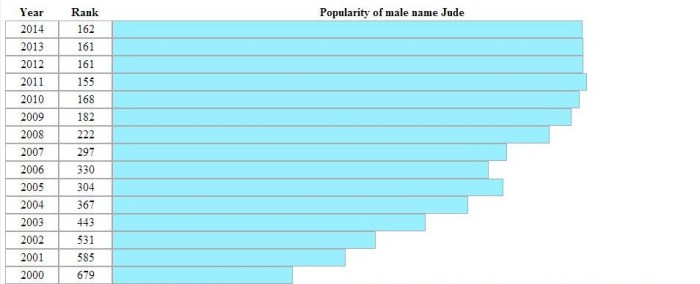
I had a sense that Jude is one of those “new” Catholicky Catholic names, in that it wasn’t used too much until recently, and I looked it up on the SSA site and lo, I was right:

jude_stats
jude_stats2


Pretty crazy popularity chart, right? Like, what’s the spike between 1955 (#954) and 1957 (#799), especially since it didn’t even make the top 1000 in 1956? Why did it decrease so much from 1977 to 1978? Why the huge jump from 1999 to 2000? I’m not going to research all that — I might be at the computer all day! — but I suspect the 1999-2000 jump is likely due to actor Jude Law, and the Beatles’ Hey Jude was released in 1968, which corresponds to a jump up. Thomas Hardy also wrote the novel Jude the Obscure in 1895, and a movie of it was released in 1996. (Did anyone see it? It’s completely unfamiliar to me.)

But for us, as I wrote here, Jude is the apostle Jude Thaddeus, the saint of desperate situations and impossible causes, hospitals, and hospital workers (all of which fits right in with the related but also separate association of St. Jude Children’s Research Hospital, which was a direct result of a prayer to St. Jude by Danny Thomas). CatholicSaints.info gives this snippet about St. Jude:

Son of Cleophas, who died a martyr, and Mary who stood at the foot of the Cross, and who annointed Christ’s body after death. Brother of Saint James the Lesser. Nephew of Mary and Joseph; blood relative of Jesus Christ, and reported to look a lot like him. May have been a fisherman. Apostle.

Wrote the canonical Epistle named for him. Preached in Syria, Mesopotamia, and Persia with Saint Simon. Healer. Exorcist. Could exorcise pagan idols, which caused the demons to flee and the statues to crumble.”

(Kind of sounds like he’s the perfect guy to turn to right now, no? Impossible causes and desperate situations … preached in Syria … exorcist …)

I hadn’t remembered that he was the brother of James — kind of cool for a family with a James to consider using Jude for another boy. I kind of love that it’s at a real peak of popularity right now too, because I feel like it’s one of those names that might have been considered … soft … for a boy not too long ago, but there are a decent amount of little boy Judes right now, so I think it’s a good time for Jude.

I really like the Baby Name Wizard entry for it too, saying it has “a pioneer style and a strong religious heritage that gives it impressive gravity. It also has a simple sound that keeps it unpretentious. The one other choice with that that same style combo is Luke, which has been a steady hit for decades. Jude is a less common alternative that is finally realizing its breakout potential.” I like that: Jude is the Luke less traveled.

A small mention should be given to the fact that Jude has some usage among girls. Martha Stewart’s granddaughter is Jude, one of Bridget Jones’ inner circle (female) is Jude, and it’s not uncommon as a nickname for Judith, though Judith is at an all time low, hovering right near the 1000 mark. Jude as a given name for girls isn’t even on the charts, so it’s a very small consideration. I would imagine that parents of boy Judes would want to avoid the possibility of it turning into Judy, but I don’t think Judy would be a huge deal, since itself is not common for girls these days anyway.

Jude can also be used as a nickname for Julian — I’ve seen it done so, and I suspect it’s because the Hey Jude song was originally Hey Jules, written for Julian Lennon when his parents split up.

What do you all think of Jude? Would you name your son Jude, or have you? Do the little Judes you know like their name? If you love the saint and would love to name a boy after him, do you prefer Jude or Thaddeus?

Spotlight on: Henry

We had some great conversations recently regarding Henry, between Dwija’s consultation post and little Henry Edward’s birth announcement post, and I kind of wanted to combine everything into one place.

So: Henry. Some Catholics have a hard time shaking the Henry VIII association. I get it, I do! But you give something power when you give too much mental energy and worry to it, you know? I’m not blaming anyone! I’m certainly not saying you’re wrong. I do believe Henry VIII would cause problems for us here if I lobbied for the name Henry, especially because my husband came from Protestantism. (And yes, I guess if the baby is #8 in a family, mayyybe Henry’s not the best name if you’re already feeling weird about the name!) But this is totally a case of needing to Reclaim the Name, because, as I said, there are so many holy Henrys. Priests and saints, men who gave their lives for the faith. I’m feeling a little weepy about their courage and their faith and how their name still has the taint of the VIII for many. They deserve better than that!

I’m loving the story of St. Henry Morse, and this gorgeous icon of him with Our Lady and Baby Jesus. Laura also referred to a documentary about his life called St. Henry Morse, Priest of the Plague, and an out-of-print book by the same name. He was one of the Forty Martyrs of England and Wales; another was St. Henry Walpole — both men killed for the crime of priesthood. St. Henry of Uppsala is another I have a personal connection with — a friend of mine specifically named her son for him, as a result of her Finnish heritage (he’s also known as Henry of FInland, and is Finland’s patron saint). He’d be a great patron for any Scandinavian boy, since he was sent to evangelize Scandinavia.

Moving a little away from Henry, which may be helpful, is John Henry, as in Bl. John Henry Newman, an Anglican priest who became Catholic, and was later named a cardinal by Pope Leo XIII. John Henry is a sweet combo that can not only soften the Protestant connection if it’s proving problematic for a couple that might otherwise like Henry, but it also pulls together a biblical name (John) with a non-biblical saint’s name (Henry) for families who want to stick with a biblical theme but might also really like Henry. (You know who you are. 😉 ) (Yes, there’s the song and story of the hammer-wielding John Henry, but that’s not a bad association as far as I can tell.)

Basically, Henry is “totes Catholic,” according to cajuntexasmom. 😀

There’s also this scene in the movie Ever After, when Danielle (Cinderella, played by Drew Barrymore) says the prince’s name (Henry, played by Dougray Scott), and it’s just the most loving thing you’ve ever heard. Every time I hear or see the name Henry, all I think is Drew Barrymore saying, “Henry” in this scene (it’s at the 2:03 mark; do be warned there’s lots of smooching before and aft).

I do think that all of this worry is a Catholicky Catholic Problem. I know loads of little Henrys whose parents likely didn’t give two thoughts to the VIII because religion isn’t on their radar as much (even Catholics), and I love hearing it and I never think of the king, only of the sweet little guy in front of me. So if those who don’t constantly think about the names of our faith can freely and happily use Henry without any problem, so much more can we, who know of the Holy Henrys!

It’s got some great nickname potential too — Hank is just to die for. Ohmygosh, a little Hank would just make me melt! There’s Harry of course, and Hal is listed as a traditional Henry nickname on behindthename.com, and I recently heard of a little Henry that goes by Huck! Huck also makes me think of Hutch, which is also awesome — neither Huck nor Hutch are traditional for Henry, but they’re totally the kinds of nicknames I would love. (Especially if paired with a middle name that would make sense of something like Hutch — like Henry Charles. Ohhhh. ❤ )

I also thought maybe Ricky — Henrik/Henryk, Hendrick, and Enric are all forms of Henry in other languages, so I feel like Ricky is a natural (if not very obvious to those who don’t know the other forms). Some of the other forms of Henry could easily be nicknamey for a little Henry too — I particularly like the Scandinavian Henning and the Scottish Hendry (though I guess it’s not really that much different from Henry).

I did a quick search for “nicknames for henry” and “Ry” was mentioned a few times (like “ree”), even morphing into Rio, which is kind of hipster (and Rio’s been calling Pope Francis to mind for me recently, because of his visit to Brazil), so that could be cool. Also Hen and Henny … I could see both being very natural and sweet on a little Henry, especially if it’s likely to just be a family nickname.

I don’t want to talk Henry to death, but I’d love to know if all this info sways you over to the Heavenly Henry side! Also, do you know any Henrys who go by a nickname different from the ones I mentioned here?

Spotlight on: Regina

Weeks ago Laura asked me to do a spotlight on Regina — I try really hard not to forget anyone’s request, even if it takes me a while to get to it. It’s been on my to-post list since then! And today’s the day, woo!

So Regina: What do you all think of when you hear it? I think of Mother Mary first and foremost — she’s always been my first association, maybe because I never knew anyone in real life with the name except for one small baby named Maria Regina, for Our Lady, so again — Mother Mary’s the big association there, for me. It’s a lot less popular than it used to be, so I imagine it might feel pretty dated to a lot of you, especially if you know women with the name.

And then there’s the pronunciation issue … how do you say it? I’ve always said reh-JEE-nah, but I understand there are some who say reh-JYE-nah, which of course rhymes with a part of the female anatomy, and even if parents are determined to have the reh-JEE-nah pronunciation, there’s still the chance that someone will mistakenly say reh-JYE-nah. (Turns out that’s the pronunciation of Saskatchewan’s capital, so … it’s definitely a possibility. Check out Abby’s profile of Regina for more info.) I can see that being the kind of thing a little girl might be mortified over (see the conversation from yesterday about names with bullying potential). (I guess a hard G is also a possibility, according to behindthename. Have you ever heard that?)

But, if that isn’t a concern, or if the intention is to put the name in the middle spot, I think this is just one of those great Catholicky Catholic names — super Marian, super traditional, *especially* paired with Maria. It’s got cute nickname potential too — certainly the familiar Gina, and also apparently Ina (Ina Garten was born just Ina though), and I think Ree could work, or Rina, or Ria.

The variants of Regina, though, are where I *think* most people of childbearing age right now would feel more comfortable: Reina/Raina/Rayna, or the Bulgarian Raya, or the French Régine or Reine (pronounced like wren, or like rain I think — the spelling Raine would make it more obvious if you prefer the latter). The Irish Ríona is quite pretty too, and I’ve also seen Regan presented as a variant of Regina, though I’m not sure how accurate that is since it was mentioned in the comments and not in the official post at BTN (and King Lear’s daughter and the character in The Exorcist ruin Regan for a lot of people, which is such a pity, because I love Regan).

What do you all think of Regina? Would you use it for a daughter? Do you know any little Reginas? What about pronunciation — how do you say it? What have you heard?

Spotlight on: Dominic

Today’s the feast of St. Dominic and I’m a Lay Dominican so it’s a ready-made name-spotlight day!

I LOVE the name Dominic. It is SO my style, SO Catholicky Catholic. Even behindthename knows it:

From the Late Latin name Dominicus meaning “of the Lord”. This name was traditionally given to a child born on Sunday. Several saints have borne this name, including the 13th-century founder of the Dominican order of friars. It was in this saint’s honour that the name was first used in England, starting around the 13th century. It is primarily used by Catholics.”

I mean, come on. So awesome. It’s not for nothing that I chose it for one of my boys’ pseudonyms on here.

I admit that, growing up, I might have thought that it was too dark and latin-y for what I assumed my children would look like until I saw Kindergarten Cop and thought I would die over how cute the little Dominic was AND he looked just like what I thought my kids would look like (and a couple of them do!). So yes, it definitely works as well for a blondie as it does for anyone of Spanish descent (like the St. Dominic who inspired this post, de Guzman) or Italian descent (like St. Dominic Savio). Actor Dominic Monaghan (LOTR! Lost!) is a good example of a non-swarthy Dominic. (Actually, there are a couple actor Dominics who aren’t Latin — Dominic Purcell and Dominic West are two such, both of English and Irish descent.) (Also, FYI, Dominic West’s first three names are Dominic Gerard Francis. His children are Martha, Dora, Senan, Francis, and Rose. So fab. Name-wise he couldn’t get more Catholic if he tried.)

Another thing I loved, surprisingly, given my all-nicknames-all-the-time way, about KC‘s Dominic is that he went by the full Dominic, no nickname. I just really love the full name, it’s so handsome. But if you want a nickname, there are a few to choose from. Dom is the obvious, and I think it could be thought of as a half step away from Tom; my dad knew a Dominic growing up and they always called him Dommy, which also calls Tommy to mind. Nic(k)/Nicky is also a possibility (as is the spelling Dominick), or Nico, especially if you go with the super Italian Domenico. Domen is a Slovak form of Dominic and Dinko is a Croatian diminutive — I could see both having potential as nicknames (though Dinko’s appeal would likely be limited). Or there’s the Basque form Txomin. (Oh my.) (I believe it’s pronounced CHO-meen — anyone know any different?)

What do you all think of Dominic? Do you know any? What does he think of his name? Does he go by a nickname?

Happy feast day!!

ETA: This is a perfect place to link to the post I posted on FB the other day — check out these new Dominican Sisters’ beaauuutiful religious names!

Spotlight on: Atticus

(I put all the giveaways in the mail this morning — look for them at the end of this week/beginning of next! And please let me know if yours doesn’t arrive!)

You’ve all likely heard the news by now, right? Beloved Atticus Finch from To Kill a Mockingbird — who actually had a whole bunch of babies named after him (name story given here, several noted in the comments here, and quite a few celeb babies who may or may not have been named for the character but there’s a high likelihood he was at least part of the inspiration) because of his goodness, and who inspired a baby name book (one of my faves: A is for Atticus: Baby Names from Great Books by Lorilee Craker) — has been shown, in Harper Lee’s new book released today, Go Set a Watchman, to not be the virtuous man we all thought him to be. (Disclaimer: I haven’t read the novel, so all my info is coming from what I read in various places, but mostly here: Review: Harper Lee’s ‘Go Set a Watchman’ Gives Atticus Finch a Dark Side.)

What a devastation for so many parents! My husband and I ourselves even considered Atticus when naming our boys, in large part because of the reputation of goodness and justice it carries because of the Mockingbird character. For us, however, a literary character, no matter how beloved, couldn’t have been the only reason to choose a name, and so I had cause years ago to look up whether Atticus is a saint’s name, and therein lies the balm for the parents of little Atticus-es: Atticus the Saint!

Parents who named their children for a good man in Atticus Finch can rest assured that St. Atticus is even better a person to be named for: he was real, for one thing, and has already finished the race and won the crown. From CatholicSaints.Info:

Atticus supported the Macedonian heresy (i.e., the Holy Spirit is not God), opposed Saint John Chrysostom, and worked against him at the Council of Oak in 405. When John was exiled fromConstantinople, Atticus assumed the bishopric in 406. He eventually realized his error, repented his opposition, and submitted to Pope Innocent I‘s rulings. He remained as bishop, but a virtuous and orthodox one, and an opponent of heretics.”

His feast day is January 8. (I do believe he’s profiled in Our Sunday Visitor’s Encyclopedia of Saints, Second Edition by Matthew Bunson, though I haven’t read it myself.) (It’s definitely on my wishlist!)

You know me — I have to have a good nickname figured out before deciding on a name — and Atticus confounded me for a while. I didn’t care for Atty because of its similarity to the feminine Addy (though I’ve seen some parents of Atticus-es saying they use Atty), but then in various places I’ve seen Ace, Gus, and Kit — all of which I think are great!

What do you all think of Atticus? Does the new Harper Lee novel tarnish it for you? If so, does its saintliness redeem it? Do you know anyone who named their son Atticus, and if so, what do they think of all this hubbub?

Spotlight on: Bernadette

A reader asked me for a spotlight on Bernadette, soooo here it is!

Bernadette is, of course, after St. Bernadette of Soubirous, the little girl who Our Lady visited in Lourdes, France eighteen times in 1858. Until today I didn’t know that she was actually named Marie-Bernarde (according to most of the sources, or Bernarde-Marie, according to the one I linked to in the previous sentence), which makes Bernadette an even sweeter name — a diminutive of Bernarde, akin to Katie for Katherine. (It also brings to mind Bl. Marie-Azelie Martin, aka Zelie — it’s Zelie that’s popular with Catholics, not Azelie nor Marie-Azelie. It’s so sweet that the affectionate nicknames are the ones we’re clamoring after.) (I also love those French hyphenated doubles, especially the ones that begin with Marie. So beautiful!)

Bernadette’s actually a special name in my family, as it’s my sister’s Confirmation name, chosen because Our Lady of Lourdes has always been special to her. I’ve mentioned this sister before — she was technically stillborn, and we attribute the return of her life to the intercession of Ven. Solanus Casey. She had spinal fusion surgery when she was in sixth grade to correct ever-worsening scoliosis, and for years afterward she put Lourdes holy water on her nape-to-tailbone scar every night. She and my dad had the opportunity to visit Lourdes a few years ago, and also to visit the incorrupt body of St. Bernadette in Nevers. My sister was able to spend time alone with Bernadette, praying in the chapel, and she and my dad (and my aunt/godmother who went with them) stayed in the convent overnight. I know it was a very special experience for her. When people ask her name, she often tells them FirstName MiddleName Bernadette LastName.

The reader who suggested a spotlight on Bernadette also indicated that the name seemed to be generating a lot of buzz recently, which I didn’t realize, but it makes sense — long Frenchy names like Charlotte, Josephine, and Genevieve are super popular right now, and Bernadette fits right in. What a sister set that would be!

Appellation Mountain discussed Bernadette here (as part of an -et/-ette post) and here (as the Name of the Day) and noted that it peaked in the 1940s, right along with the release of the Academy Award-winning movie The Song of Bernadette, so it still has a grandma feel to it. Recent popularity may be due in part to the (super smart) character Bernadette on the show The Big Bang Theory (whose character, incidentally, is from a big Catholic family), and probably also because French names are currently popular. Or maybe because St. Bernadette’s waving from heaven with the Immaculate Conception and Catholic parents are noticing? 🙂

Whatever it is, it seems to me an easy nickname is a must, what with all the Charlottes/Josephines/Genevieves called Charlie/Josie/Evie. There’s Bernie, which I think is still out of touch with most of today’s namers. Benny seems fresher, and is totally doable and adorable. Or Etta/Etty. Or — and I think this is my fave, and I’ve mentioned it before — Betsy, as one of my friends was considering using as a nickname for Bernadette. Abby also mentions Betty, Bette, and Bebe.

What do you think of Bernadette? Would you consider it? Have you considered it? Have you gone ahead and given it to one of your daughters, or do you know a little one named Bernadette? If so, what does she go by — the full Bernadette, or a nickname?