Cultural appropriation?

I had a conversation a while ago with a woman I know who was due soon with a little girl and still trying to figure out a name. In the course of the conversation I suggested Pilar as a middle name idea — it flowed really well with the first name ideas on the list she and her husband had compiled, and though neither she nor her husband are Hispanic, they are into more unusual Catholic names, and of course Pilar’s Marian, and you know me, always trying to get those Marian names in there. So I was really surprised when she said she’d run Pilar by her husband and he’d said no because he’s “not into cultural appropriation.”

I was so taken aback! I honest-to-goodness never considered that any of the names associated with our faith would be a problem for Catholics, whether they be the names of saints from other countries (or our own) (I’m looking at you, St. Kateri) or titles of Mary in another language — I’ve always just figured that it all belongs to all of us. Like, such names *are* our culture — Catholic culture, which embraces and celebrates — and transcends — human culture. Even after thinking about it for the months since I had that conversation, I’m still of the opinion that it’s all okay.

I totally get that the woman’s husband was just expressing his personal preference to not use names of a culture that’s not his nor his wife’s — which is totally fine and understandable! And it probably has just as much to do with the fact that he probably just doesn’t like Pilar anyway — it was just the use of the term “cultural appropriation” that gave me a start, being politically charged as it is.

I suspect I know what you all think, you non-Native American parents of Kateris and non-Spanish parents of Xaviers 😏,  but I’m still interested in hearing your thoughts on this. Do you think there are any Catholic names that are off limits for Catholics for reasons related to “cultural appropriation”?

Yummy tidbits, and a new page

Thank you all for your responses on FB to my earlier request for prayers for a mama in labor, and for all of you who prayed for her! You’re all wonderful! As soon as I have an update and am given the go-ahead to share it, I will.

As a special summer vacation treat for myself 😄 I’ve been reading through all of Swistle’s birth announcement posts. I’ve been doing it for weeks now and I’m on page 44 — going back to 2010 and 2011! As a side note, it’s really interesting to read which names were still considered kind of weird back then that are used regularly now (of course I’m blanking now on even one example … maybe Penelope?), but what I really wanted to post here were the couple that really jumped out to me as amazing or interesting. Like this sibset:

Baby Boy Finchlee, Brother to Wilhelmina, Calista, Zachariah, Theodore, and Philippa. They go by Willa and Calla (twins, love!), Zak, Ted, and Pippa. The name they ended up choosing for their little boy is PERFECT, beyond perfect, I’m dying over it! 👍👐👌 You just have to read the whole post to get the whole story and all the elements!

I love this one too, because of the first paragraph:

Our son is named Giovanni Paolo. I know- Italian overload- but his name has significant meaning to us. He was named after Pope John Paul II who wrote extensively on marriages and families and really inspired my husband and I in our Catholic faith, which is really important to us. I am not tied to sticking with Italian names; we were just attracted to name his Giovanni Paolo instead of John Paul, since John Paul just seemed too ordinary to us. We absolutely love his name, and call him G for short.”

(They didn’t continue the Catholic theme though.)

I also liked the idea in this one of Caia as a nickname for Caterina. Kinda cool! (Swistle did not agree — she’s distinctly anti-unusual nicknames and even usual ones — she even fusses about Ellie not being a traditional nickname for Elizabeth!)

This is actually a good opportunity to tell you about yet another new page I’ve recently started, somewhat inspired by my reading of the old Swistle posts — it’s the Helpful naming tips and info tab up at the top, and I’ve been slowly adding in there comments from here and posts from here and elsewhere that I think are helpful when naming a baby in general, and a Catholic baby in particular. It’s definitely a long-term, ongoing project, and will hopefully be of use to you all!

I’m sure I’ll have more to share from Swistle’s archives as I keep working through, stay tuned! 😀


Baby name consultant: Benedict Arnold or Robert E. Lee?

This week’s consultation is a bit different, in that the mama who wrote to me had specific questions about two names she and her husband are considering for their son. She writes,

My husband and I are down to two names for our second boy but see potential issues with both. The first is Benedict Joseph for Pope Benedict. The second is Robert Edward for my paternal grandfather and my father in law. We worry that because we live in the Washington DC area, both names could cause issues because of Benedict Arnold and Robert E. Lee. Obviously Robert Edward wouldn’t be a big deal if it wasn’t for our last name that sounds similar to Lee.

Are we just being crazy? I should probably mention that my husband, my father in law, and I all obtained degrees in Political Science with varying emphases on American history and law.”

Interesting questions, right?

Objectively, I love both names — saintly, handsome, really great. Regarding the Benedict Arnold conundrum — I don’t know! I know some might make the connection and have a problem with it, but in my world Benedict Cumberbatch and Pope Benedict are the two overriding associations.

Regarding Robert E. Lee, I would never think of Robert E. Lee if I were to hear of Robert LastNameThatSoundsSimilarToLee (no mention of middle initial). But maybe I would if I heard Robert E. LastName? Even so, that association wouldn’t bother me one bit, since Robert E. Lee is so far away from any potential baby name inspiration on my part. But in this mama’s world of American history and law and her geographic location? It’s a great question! I really wanted to post this dilemma in order to get feedback from all of you!

Another thought I’m having is Bennett instead of Benedict — Bennett is a medieval form of Benedict, so they would be able to honor the man in a less politically charged way and still use the nickname Ben. Or Robert Benedict, which is so handsome, and I think solves all their problems above and below.

I do have some other thoughts though, that the mama didn’t ask for but I feel is my duty as a name consultant to point out! So sorry in advance! I loooove Pope Benedict so much and I love to see babies named after him! But I find that middle names for Benedict are kind of hard, as the initials can be problematic and I do feel like I have to point them out to parents, just so they know what they’re getting into. BJ and BF have sexual connotations; BM has toilet associations; and BO has body odor associations (though I had a friend BJ in high school and I don’t remember anyone teasing him about his name, so if they don’t mind it and just own it, it could be just fine. I definitely want to hear all your thoughts on this issue as well!). BR however is a great combo — maybe Benedict Robert could work instead? Or Benedict Edward?

So, to recap, my two heartiest suggestions are Benedict Robert/Edward and Robert Benedict. 🙂 Robert B. LastName is especially great to me — they get our Pope Emeritus in there without any Benedict Arnold associations, they retain a family connection with Robert (and I’ve seen Ned as a nickname for Benedict, and it’s also a traditional nickname for Edward, so maaayyyybeee they could spin it that Benedict is for Ratzinger AND Grandpa Edward? I know that’s a big stretch), and there would be no Robert E. Lee issues.

Or use Joseph to honor Benedict instead, in either the first or middle spots? Robert Joseph? Joseph Robert?

What advice do you all have for this family?

New CatholicMom article up

My June CatholicMom.com article posted yesterday, and I’m eager to hear your thoughts on itcatholicmom_screen_shot-06.16.16 — it’s a topic I’ve been thinking about for a while: Name definitions vs. name meanings
I have a few people to thank for their role in the writing of this article — Jen, for sending me the Brandon Vogt FB post that he then published on Catholic Pop (and Brandon Vogt himself, who wrote the post that Jen sent), and Abby at Appellation Mountain, whose Mallory quote I’ve been thinking about for a long time and I’m delighted to finally use it in a piece. Also the mama who I was emailing with recently who was worried that Lydia didn’t mean anything more than “from Lydia” and would therefore make a questionable name choice. I hope this piece is helpful to her and anyone else who feels hindered by name “definitions”!

Popularity of Zelie in 2015

Because of Zaylee appearing in the top 1000 in 2015 and the comments (here and here) on my post from this morning regarding Zelie/Zaylee I looked up Zaylee, Zelie, Zellie, and Azelie, and discovered Azaylee as well!, to see how many babies were so named in 2015:

Azaylee: 9
Azelie: 17
Zaylee: 270 (rank #990)
Zelie: 50
Zellie: 12

It was interesting to compare the numbers to 2014:

Azaylee: 7
Azelie: 6
Zaylee: 182
Zelie: 25
Zellie: 9

Azaylee’s making me think (as the other Kate pointed out) that the popularity of Zaylee may indeed be influenced by St. Zelie. Fascinating!

Updated to add the numbers for Azelia, which Andrea included in her comment at the same time I was posting this! There were 24 babies named Azelia in 2014 and 25 in 2015. (She also included info for Therese and Louis, if you’re interested — there was no significant impact on either one.) Thanks Andrea!

2015 SSA name data released

For the past week or so I’d been seeing the name bloggers eagerly anticipating the release of the 2015 name stats from the Social Security Administration — it’s only because of them that I knew it was going to happen today, because I’m the absolute worst at being in the know and at the right place at the right time and the first one with the breaking news and all — I was actually stressed out at the idea of having to blog about it quickly and though I’d wait until tomorrow to do it. I’m so. weird.

But I took a look at the list this morning, and had a couple things to say so I thought I *would* post about it today after all, as I should, being a name blogger and all, and I’d love to hear your thoughts too!

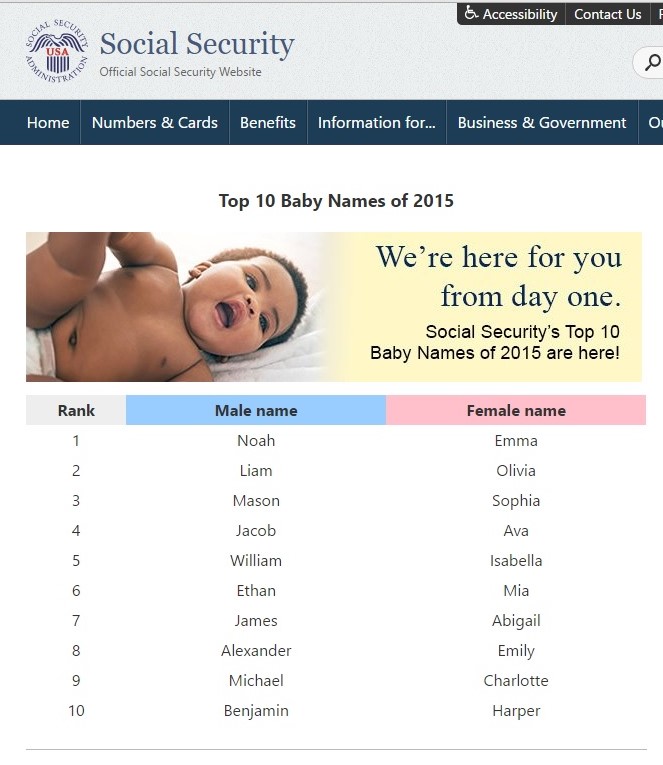
2015_top_ten

My first reaction was absolute shock that Harper is now in the top ten for girls. Wow! I had NO idea it was that popular!!

Noah and Emma retained their #1 spots, and I’m feeling surprised by that because the people I discuss names with (mostly all of you) tend to stay away from those names because of past popularity, so all I hear about them is that they’re generally not being used. But they’re great names and pretty “normal” (not like Abcde, for example), so I’m not disappointed that they’re the names on top.

I also took a quick look at the names that increased in popularity from 2014 — Alaia had the biggest increase for girls, jumping up 2012 spots from #2676 in 2014 to #664 in 2015! WOW!! Others that jumped up more than a thousand places are Meilani, Aitana, Aislinn, Taya, and Adeline (I love Aislinn and Adeline).

The boy name with the biggest increase is Riaan, up 1360 spots from #2286 in 2014 to #926 in 2015. No other boy names increased by a thousand or more — the next closest was Huxley, up 392 spots from 1354 to 962.

I didn’t scrutinize the list, but the other name that jumped out at me was Zaylee — #1304 to #990. I can’t imagine that’s influenced by our St. Zelie, since so many of us aren’t even sure how to say it, so I assume it’s a Baylee/Kaylee name … what a weird and interesting convergence of super Catholic and super trendy!

No shock at all was the fact that the girl name Isis took the biggest hit, decreasing 1065 spots from #705 to #1770. Maybe I’m surprised it didn’t fall farther?

That’s all I have to say for the moment, but be sure to check out those who have a better handle on it all than I do — some good analysis in these pieces, and more will be coming in the next few days I’m sure:

Appellation Mountain: Harper and Benjamin Enter the US Top Ten! (Abby had made some great predictions — including that both Harper and Benjamin would enter the top ten! Wow!)

Nameberry: Emma and Noah Top Baby Names List … Again

Baby Name Wizard: The Most Popular Baby Names in America for 2015

New Nameberry article up!

I know I’ve told you all a hundred times before, but you make this blog. Without you guys, it would just be my personal online name file folder with all the tidbits I want to keep together in one place, but with you — Sancta Nomina sings!

Yet another example of your invaluable input is my latest piece up at Nameberry: Baby Names Quandary: Use it now or bank a name you love?

nameberry-05.03.16

The comments you left on this consultation (Felix now or Felicity later?) and this post on whether or not you reserve names for later use and this post on naming regret informed the article, and I think a lot of parents will benefit from our collective wisdom. So thank you again! ❤

Names for the Luminous Mysteries

Today marks the last post in our Mysteries of the Rosary series as we conclude with the Luminous Mysteries!

I know I went out of order, but it all made so much sense: I posted the Sorrowful Mysteries during Holy Week; the Glorious during the octave of Easter; the Joyful the day after the Feast of the Annunciation; and today’s Luminous Mysteries (also known as the Mysteries of Light), which were added to the Rosary during the Year of the Rosary by our beloved St. John Paul the Great in his beautiful Apostolic Letter Rosarium Virginis Mariae (October 16, 2002), come a day after the feast of St. Stanislaus of Cracow, to whom JP2 had a great and subversive devotion. If I can digress for a moment, this is one of my favorite JP2 stories:

A controversy arose [in Poland] over the proposed dates of John Paul II’s visit. The pope wanted to arrive to celebrate the nine hundredth anniversary of Poland’s patron saint, St. Stanislaus, whose feast day is traditionally celebrated on the first Sunday after 8 May [only in Poland — we celebrate it on April 11]. In 1079, Stanislaus, the bishop of Cracow, was beheaded by King Boleslaw II for denouncing royal oppression and fomenting a baronial rebellion against him. The legend of St. Stanislaus represented the moral justification for resistance to an oppressive state under the courageous leadership of the church. It linked Catholic morality and Polish history. While Stanislaus’s martyrdom resonated with the pope’s message supporting human rights, this was just the type of symbolic linkage the regime wanted to avoid.

The party opposed the May dates requested by the pope. While First Secretary Gierek wanted to welcome John Paul II in order to show that the PZPR was patriotic and one with the nation, he did not wish to strengthen the opposition or provide occasions for antiregime demonstrations. As Central Comittee secretary Stanislaw Kania put it: ‘Above all … the state leadership wants to demonstrate its happiness with the selection of a Polish pope.’ Gierek and Cardinal Wyszynski met to discuss the broad outlines for John Paul II’s visit. Then a special church-state commission spent many weeks working out the details. They finally reached a compromise: the church conceded that the pope would not come for the May anniversary of St. Stanislaus; instead John Paul II would visit in June but stay longer. The government agreed that the pope would be invited for nine days and would be allowed to visit six cities (rather than the two originally requested). Once the matter was settled, the ‘Polish church immediately announced a delay in the official [St. Stanislaus] anniversary celebrations until the Pope arrived.’ To add insult to injury, Pope John Paul II made it a point to mention St. Stanislaus in every sermon and at every stop along his journey. As masters of symbols and ceremony, the Polish church leaders were far more accomplished in public relations than their state functionary counterparts. IT was not going to be easy for the Communists to thwart the pope’s intentions for his pilgrimage.” (From Solidarity and contention: networks of Polish oppositions by Maryjane Osa, pp. 139-140)

That visit had huge repercussions (this and this are also quite good) and indeed it is said that ” John Paul II’s 1979 trip was the fulcrum of revolution which led to the collapse of Communism.” I can barely write it, so moving I find it all to be. That man. His courage. Thank God for him. ❤ ❤ ❤

Anyway! ((wipes eyes before continuing)) These are the Luminous Mysteries (read more here) (and here’s how to pray the Rosary):

The Baptism of Jesus in the Jordan
The Miracle at the Wedding Feast of Cana
The Proclamation of the Kingdom
Jesus’ Transfiguration
The Institution of the Eucharist at the Last Supper

Names associated with the Luminous Mysteries might include:

Girls

Alazne — Basque for “miracles” (right skimac? and how is that pronounced?)

Cana — the place of the wedding feast where Jesus performed his first miracle (we have a reader who gave her daughter this amazing name!)

Charis — from the Greek for “grace, favor, gratitude” and is contained within the word Eucharist (“thanksgiving”)

Christi — Latin for “of/belonging to Christ,” inspired for this list by the Eucharistic phrase Corpus Christi (“the body of Christ”)

Clare, Claire, Chiara — from the Latin for “clear, bright” as a nod to the Mysteries of Light and the brightness of the Transfiguration

Evangeline — for the Good News — the proclamation of the kingdom

Jemima — means “dove,” for the “Spirit of God descending like a dove” on Jesus during His baptism

Jordan — the name of the river in which Jesus was baptized

Lucy, Lucia, Lucille — from the Latin for “light”

Mary, et al. — for Our Lady, who brought Jesus’ attention to the wine crisis at the wedding (“He did it because His mother asked Him to!” I frequently tell my boys. 🙂 )

Maya, Mayim — from the Hebrew for “water,” as a nod to Jesus’ baptism

Milagros — Spanish for “miracles,” as a nod to Jesus’ first miracle at Cana; see Alazne

Paloma — means “dove”; see Jemima

Ruby — “red,” for Jesus’ Blood given to us at the Last Supper

Scarlett — same as Ruby


Boys

Baptista, Baptiste, Battista, Bautista — referring to Jesus’ baptism and to the one who baptized him (John the Baptist) (these are all listed as masculine by behindthename, but they could easily be used for girls as well, as I don’t think they come across as masculine [or at least not exclusively so] in America)

Colum, Columba — means “dove”; see Jemima

Conway — possibly means “holy water” in Welsh

Elijah — he appeared to Jesus during the Transfiguration, and Jesus spoke with him. See also Moses. “Moses and Elijah represent, respectively, law and prophecy in the Old Testament and are linked to Mount Sinai … They now appear with Jesus as witnesses to the fulfillment of the law and the prophets taking place in the person of Jesus as he appears in glory.”

James — one of the Apostles who witnessed Jesus’ Transfiguration; see also John, Peter

John — the one who baptized Jesus; also the only gospel that contains the story of Jesus’ miracle at the wedding feast at Cana; also one of the Apostles who witnessed Jesus’ Transfiguration (see James, Peter)

Jonah — means “dove”; see Jemima

Jordan — the name of the river in which Jesus was baptized

Lucian, Lucius — see Lucy

Moses — see Elijah

Peter — see James

River — for the River Jordan

Tabor — Mt. Tabor was where Jesus’ Transfiguration occurred

I can’t wait to see what others you can add to this list!

+ “This is my beloved Son, with whom I am well pleased.” … “Do whatever He tells you.” +


Name signs for those who use American Sign Language

Our reader Amy is deaf, and was recently sharing with me how name signs are bestowed, which I thought you’d all find as interesting as I do:

In regards to naming practices for people who use American Sign Language*:

Culturally, a name sign should only be given to you by a Deaf person (you can’t just make up your own) and they are also not always bestowed right away. Sometimes it can takes months or longer while you wait for the right one to come along. Until then, names are typically just finger spelled. Sometimes short names (2 or 3 letters) are only finger spelled and that motion becomes their sign. But for the most part name signs are given based on a characteristic unique that person. Like Callie might walk with a specific sway in her hips, so hers might be a C hand shape near her hip that rocks back and forth. Rachel might be a person that is always happy and smiling so the sign for smile is done with the handshape for the letter R instead of the regular hand shape. Gavin might be a G on his upper arm because he is strong.

The first initial is not always used. I know an Anna who had chubby cheeks as a baby so her name sign is a finger flick on her cheek. Caleb might be a claw hand shape, finger tips almost tapping his chin. My co-worker Jill’s sign name is the same as the sign for flower because it relates to her maiden name. I have a friend who didn’t “name” her son until he was almost one, and then he was “named” after an eyebrow raise he would always do. The hand shape/movement mimics it.

In my own family we use the letters MK for my son Martin Kane, as a way of including his formal first name, even though we call him Kane. Also because we already use a K hand shape for my daughter Kristy (palm facing in, rising up from her ear because she would always make high squeaky sounds and she is hearing). My name (Amy) is just finger spelled, My husband Marty’s is an M making an arch down like the sign for kung fu because he is a black sash, an instructor and it’s where we met. Sometimes just generic signs are used. A good example of this might be when reading a story book. Instead of spelling the characters names over and over again or coming up with a characteristic name sign, you could just simply shake the first letter in the air or tap it on your jaw if the character is female, or on your temple if they are male (because this is where female/male signs are made). Fun stuff huh! Although, working in a deaf school, sometimes it gets confusing when students have the same name sign or ones very similar. But then again, regular school kids have this same problem. Common top 10 names usually end up going by their first name plus their last name initial. Emily C. or Emily K.?

*some names in this post have been changed to protect privacy

So interesting, right? I always wondered how people got their name signs! I took Sign Language classes for years before and during college, which were taught by a hearing interpreter, so she knew a lot but she wasn’t deaf (I don’t know how much “insider” cultural info she had) and I didn’t know to ask about this (we all finger spelled our names) — this is all new to me!

I also really like how the name signs are tied to a characteristic that is particular to each individual, and how it “Sometimes it can takes months or longer while you wait for the right one to come along. ” It feels really affectionate to me because it requires observation of the person — you have to really *know* him or her.

Amy also told me, which I hadn’t known, that St. Francis de Sales is the patron of the deaf — such a cool thing to know! I love him! (He’s also a patron of writers, and I’ve long asked him for intercession for my writing efforts.) I looked him up, just to see if I could find an explanation for this particular patronage, and found this amazing tidbit:

His simple, clear explanations of Catholic doctrine, and his gentle way with everyone, brought many back to the Roman Church. He even used sign language in order to bring the message to the deaf, leading to his patronage of deaf people.”

That.is.awesome. ❤

Do any of you know anyone with a name sign, and if so, what is it/how did they get it?

Thanks to Amy for writing this up for us!!

Names for the Joyful Mysteries

Yesterday was one of my very favorite feast days and the first of the Joyful Mysteries, which makes today the perfect Tuesday to post names associated with them! And also, Dwija’s little Helen was discharged from the NICU yesterday and is home with her family, happy and thriving. Joy all around!!

Today’s post is a continuation of my Mysteries of the Rosary series, having already done names for the Sorrowful and Glorious Mysteries, and your comments have been invaluable — keep them coming!

These are the Joyful Mysteries (read more here) (and here’s how to pray the Rosary):

The Annunciation by Gabriel to Mary (yesterday’s feast!)
The Visitation of Mary to Her Cousin Elizabeth
The Nativity of Jesus
The Presentation of the Baby Jesus in the Temple
The Finding of the Child Jesus in the Temple

Names associated with the Joyful Mysteries might include:

Girls

Angela, Angeline, Angelica, Archangela, Angel — the angel names all point to St. Gabriel

Annunziata — an Italian name referring to the Annunciation

Annunciación — a Spanish name referring to the Annunciation

Christina, Christine, Christiane/a, Kristin, etc. — the Christ- names refer to Jesus in the last three Mysteries

Elizabeth, Elizabeth, Elise, Elisa, Eliza, etc. — for St. Elizabeth, Our Lady’s cousin

Emmanuelle, Emmanuella — for Jesus, especially in the Nativity

Felicity, Felicitas — means “happiness,” for the Joyful Mysteries

Fiat — for Our Lady’s agreement to what Gabriel announced (“let it be done”); Amy suggested Fiat recently, and suggested the particular first name-middle name combo Marian Fiat

Gabrielle, Gabriela — for St. Gabriel

Jane, Joan, Jo(h)anna — for St. John the Baptist, who leapt in his mother’s womb for joy at being in the presence of his Unborn Savior

Josephine, Josefa — for good St. Joseph

Joy, Gioia — means “joy” in English and Italian, respectively

Joyce — behindthename says it originally came from a name meaning “lord,” and that its more recent popularity may be related to its similarity to the Middle English word for “to rejoice.” “Lord” or “rejoicing” — it’s all good for a Joyful Mysteries name!

Mary, Maria, Marie, etc. — for Our Lady, of course

Natalie, Natalia — literally refers to Christmas Day

Noel, Noelle — French for “Christmas”

Presentación — a Spanish name referring to the Presentation

Seraphina, Serafina, Seraphine — refers to the angels (specifically the seraphim, but I think the angelic meaning is what most people think of)


Boys

Angelo, Angel — see the Angel names above

Annunziato — see Annunziata above

Baptista, Baptiste, Battista, Bautista — alone or in combination with a John name, for St. John the Baptist (these are all listed as masculine by behindthename, but they could easily be used for girls as well, as I don’t think they come across as masculine [or at least not exclusively so] in America)

Christian, Christopher — see the Christ- names above

Emmanuel — see Emmanuelle above

Felix — see Felicity above

Gabriel — of course!

Jesús — it’s not considered reverent to use the name of Jesus in English, but it is in Spanish

John — for St. John the Baptist

Joseph — see Josephine above

Noel — see Noel above

Ryan — means “little king,” which especially calls to mind the Baby Jesus

Seraphim — see Seraphina above

What others can you add to this list? (There are lots more Christmas names, which I’ve posted about a few times — I just included the ones here that seemed particular to what I think of when I’m meditating on the Mystery of the Nativity.)

+ My soul proclaims the greatness of the Lord; my spirit rejoices in God my Savior. +