Spotlight on: Lily

Months ago one of you asked me via email if I would do a spotlight on Lily, and I’m delighted to oblige today!

There’s so much to say about Lily! First: the flower. The lily is a gorgeous flower, and a gorgeous flower name; as such it can fit in well with other nature-y names from Rose and Heather to River, Willow, and Sage. I love versatility! The lily flower also has a bunch of faith connections — according to this site they include:

The lily is a symbol of purity, and has become the flower of the Virgin. Originally, in Christian symbolism, the lily was used as the attribute of the Virgin Saints. The lily among thorns has become a symbol of the Immaculate Conception of the Virgin because of the purity she preserved amid the sins of the world.  The Annunciation, is very much associated with lilies. In many of the scenes of the Annunciation executted [sic] during the Renaissance, the Archangel Gabriel holds a lily, or a lily is in a vase between the Virgin and him. Thus, the lily is also an attribute of the Saint Gabriel.
 
Sometimes the Infant Christ is represented offering a spray of lilies to a Saint, symbolizing the virtue of chastity. As a symbol of chastity, the lily is the attribute of several Saints, among them St. Dominic, St. Francis, St. Anthony of Padua, St. Clare, and St. Joseph. The fleur-de-lis, a variety of lily, is the emblem of royalty. A fleur-de-lis was chosen by King Clovis as an emblem of purification through Baptism, and this flower has since become the emblem of the kings of France. This is why the flower is the symbol of St. Louis of France and St. Louis of Toulouse, both members of the royal house of France. The fleur-de-lis was also the emblem of the city of Florence. As an attribute of royalty, the fleur-de-lis appears on crowns and sceptres of kings and Saints, and is given to the Virgin Mary as Queen of Heaven.

… The lily of the valley is one of the flowers that signals the return of spring. For this reason it has become a symbol of the Advent of Christ. The whiteness of its flowers and the sweetness of its scent it is a symbol of the Virgin Mary, especially of her Immaculate Conception. The latter meaning is based upon Canticles 2:1 ‘I am the flower of the field, and the lily of the valley.'”

A more compact list of holy people and events with whom lilies are associated is here. I also liked this bit from this site:

Flower associations with Mary’s divine prerogatives include, for example, those associated with her Assumption … Among these are the apocraphyl legend of the roses and lilies found in p[ace [sic] of Mary’s body in her tomb; St. Bede’s 6th Century discernment of the tranlucent [sic] whiteness of the petals of the white lily as symbolizing the purity of Mary’s body and the gold of its anthers as symbolizing the glory of her soul, as she was assumed into heaven … Besides the Assumption flowers previously mentioned, there is the white day lily, known as Assumption Lily from it’s mid-August bloom around the time of the August 15th liturgical feast of the Assumption

So lots of beautiful connections for Lily!

But wait! There’s more!

Lily is also a traditional nickname for Elizabeth! Abby at Appellation Mountain explains it thusly:

Before you cry, “No, nope, never – Lily just cannot be a nickname for Elizabeth. That’s all Lillian,” pause and consider this. Lily and Lillian probably started out as nicknames for Elizabeth, at least some of the time. My best guess is that the overwhelming majority of people don’t know this – I’ve found a few message boards with comments like “Lily is not a nickname for Elizabeth.” So, okay, it’s not common knowledge. But that doesn’t mean it isn’t so. The current Queen of England, Elizabeth II, was called Lilibet as a child, which makes me think that the Lily-Elizabeth connection was alive and well until sometime in the early twentieth century.”

At least one of you readers has a daughter named Elizabeth who goes by Lily (you know who you are! If you want to chime in, please do! 😊), I love that option! (I spotlighted Elizabeth here.)

There are lots of Lily names, all of which can trace back to the same faith connections mentioned above. Of course there’s Lillian, which is perfectly in tune with names like Alice, Clara, and Eleanor. Liliana is another gorgeous option, which pulls in St. Anne. 🙂  (Liliana could totally be a Mary+Anne name, or an Elizabeth+Anne name, love it!) Lilia/Lilya is a Slavic variant that I love so much it’s on my long list. Lilly, Lilli, Lili are all legit variant spellings of Lily.

What do you think of Lily, and/or what more do you know about it? Would you name a daughter Lily, or have you? If you would/did, would Lily be the name on the birth certificate, or would it be a nickname for something longer — and if so, what?

Updated to add: How could I forget to include the connection to St. Kateri?? She’s known as the Lily of the Mohawks. 💕

Spotlight on: Benedict/a

I haven’t done one of these in ages and it feels goooood to work on one! 😀

One of you dear readers asked me for a spotlight on Benedicta a while ago, so I thought it would be best to add in Benedict as well, as Benedict is the “originating name” in the sense that it was a name first, and then the female variant arose. (Withycombe says that Benedicta is, “Probably as a rule simply a f. form of Benedictus, the man’s name, though there are one or two obscure saints Benedicta.”)

Benedict/a’s meaning rocks: “blessed.” So great, right?! And for us, it also means “any of the Sts. Benedict, and/or the Benedictine Order (especially for those who have a Benedict spirituality), and/or our dear Papa Benny — Pope Emeritus Benedict XIV (aka B16 because we Catholics are cool like that, giving our popes hip nicks. 😀 ).”

Speaking of hip … this image of St. Benedict always kills me, he looks so cool, like he’s just wearing his hoodie, hanging out with friends, like (Catholic nerd alert!) your favorite young seminarian or director of campus ministry. 😀 I hope it isn’t disrespectful to say so! It’s my favorite image of him, and if I ever have a Benedict, I’ll get this icon for him.

st_benedict_of_norcia
Hoping it’s okay that I’m including this screen grab — I’ve seen this image all over the internet and only tonight discovered who wrote it — great job, Br. Claude Lane! I got it from Mount Angel Abbey’s web site.

I know some people have a hard time moving past the Benedict Arnold association that, unfortunately, continues to cling stubbornly to the name, but fortunately that’s only an American problem, and Pope Benedict, Benedict Cumberbatch, and time have all helped to dilute it, and will continue to do so I’m sure.

Benedicta suffers from no such problematic association, as far as I’m aware, and Simcha Fisher’s little Benedicta Maribel — called Benny exclusively and swoonily — is a tremendous example of how such a big name can work on a beautiful little girl.

As far as nicknames go for Benedict, there’s Ben and Benny, and I’ve suggested Bede as a nickname for it, and I’ve recently been loving the idea of Boon(e) as a nickname for it too, if you want something a little offbeat — it means “good,” a similar meaning to Benedict, which just adds to its possible use as a nickname for Benedict in my opinion (Abby did a post on Boone not too long ago, which I loved). I’ve also seen Ned (and Neddy!) — seriously adorable! Benito is a Spanish variant (though … is the Mussolini connection still too strong?) and Benedetto an Italian variant, and I think some of the other foreign variants could really work as nicknames or given names too, like Bendt/Bent (Danish), Bence (Hungarian), and Bento (Portuguese).

For Benedicta, there’s of course Benny and I think Betty, Neddy/Nettie, and even Becka could work. (Which makes me think — Beck could work as a nickname for Benedict too! Fun!) I could see Bonnie working for a girl as well. Benita is a Spanish form and Benedetta an Italian form (and Bettina its diminutive). Pretty!

I can’t not mention also Bennett/Bennet/Benett/Benet/Bennitt — medieval variants of Benedict that can be a little easier to bear while still retaining the saintliness of the name. Withycombe even says that those same variants were used for girls as late as the end of the 17th century! She also says that the surnames Benn and Benson were derived from Benedict, which provide further ideas.

All in all, I think Benedict and Benedicta are great names, very usable. I’d love to hear from any of you who have a Benedict/a or know any — do they like their name? Do they go by a nickname and if so, what is it?

Spotlight on: Juliet(te)

Ages ago Grace asked for a spotlight on Juliet(te), specifically to figure out the faithy connections. Juliet is one of my favorite favorite names, and I’m delighted to finally post this spotlight!

So Behind the Name tells us that Juliet is an anglicization of Juliette or Giulietta, which are diminutives of Julie or Giulia, which are the French and Italian variants of Julia, which is the feminine form of Julius, and it’s through Julia and Julius that Juliet(te) gets its faith significance.

As the DMNES points out, Julius is Caesar, and also three popes, one of whom is a saint. Julia is a figure in the New Testament, greeted by Paul and numbered among other “holy ones” (Romans 16:15) as well as several saints (CatholicSaints.Info offers a whole bunch of Sts. and Blds. Julia, as well as several Sts. Julius. Focusing on the holy women, a couple that jump out at me include Bl. Rose-Chretien de Neuville, one of the Carmelite Martyrs of Compiegne whose religious name was Sr. Julia Louise of Jesus; the more recent St. Giulia Salzano, who had a devotion to Our Lady and the Sacred Heart of Jesus and was canonized by our Pope Benedict; and St. Ursula Ledochowska, whose birth name was Julia — she started the Ursulines of the Sacred Heart and her body is incorrupt. And others! Regarding Juliet specifically, there’s a devastatingly sad Golden Legend entry about St. Juliet, aka Julitta and Juliot, and her son St. Quirine, aka Cyriacus, which may or may not be true.)

So Juliet(te) has some impeccable credentials faith-wise! I suppose the question becomes, do you prefer just Juliet/Juliette, or would you rather use it as a nickname for Julia? I think using Juliet/Juliette as a nickname is pretty rare, but I love the idea of it because it offers more options, and it’s also so sweet! I always think of diminutives as being particularly lovey, so calling a Julia “Juliet” I think makes it seem really like, “Oh my sweet little Julia!”

And which spelling do you prefer? Juliet, Juliette, or even Juliot like the old French? And do you nickname a little Juliet? We’re big nicknamers here, and I think the full Juliet would automatically get shortened to Julie or Jules, which aren’t my favorite … I’ve seen Jilly as a nickname for Julia, which I think is sweet, and I think it could work for Juliet. Or Jet, which is edgy and cool, so if your Juliet decides to punk out when she’s a teen she could have all her friends call her Jet. I love that idea more than I probably should! 😂 ✈✈✈ There’s also the old nickname-from-a-mashup-of-first-and-middle, so Juliet Noelle can become Juno or Junie. But I think, if it were me, I’d really push for the full Juliet, it’s just so beautiful.

Also, Catholic Digest Editor-in-chief Danielle Bean has a Juliette, and mentions the thing any Juliet(te) will have to deal with: Romeo. She says it’s no big deal, and it isn’t to me either, but maybe you all feel differently? Even with the Romeo connection, I feel like it gives Juliet all the good feels from that story (sweet young love, romance) and none of the bad (foolish youth, defiance, disobedience, suicide). Do you agree?

What do you all think of Juliet(te)? Would you or have you named a daughter Juliet(te)? Do any of you know any Julias who go by Juliet(te)?  Do you know any Juliet(te)s who go by a nickname?

Spotlight on: Elizabeth

Grace asked for an Elizabeth spotlight a while ago, which is so great, because when I think of doing spotlights, I tend to think of names that are a little unusual or offbeat or have issues (like, what nickname? how does this name come across? does this name have any saintly connection?), and since I don’t consider Elizabeth to fall in any of those categories, I probably wouldn’t have thought to spotlight it.

But Elizabeth — I mean, come on. Is there any more impeccable name than Elizabeth? I love so many things about it, like:

It’s the name of Our Lady’s beloved cousin and mother of John the Baptist, known as St. Elizabeth of the Visitation (I love that!). Her Mystery of the Rosary is a tremendous pro-life witness and the first announcement to those other than Jesus’ parents that the Messiah had come.

It’s the name of a sainted queen (St. Elizabeth of Hungary) and an Irish martyr (Bl. Elizabeth Kearney) and two wives of men who lived Godless lives and converted and became priests after their wives’ deaths (SOG Elisabeth Leseur and Bl. Elisabetta Canori Mora) and a whole bunch of other holy women. One of them, Bl. Elizabeth of the Trinity, is set to be canonized this year, having had her second miracle recently approved.

It has about a thousand variations — not only Elizabeth, Elisabeth, and Elisabetta as mentioned above, but also:

elizabeth_screen_shot
http://behindthename.com/name/elizabeth

So many cool options! Two really unusual ones (to me) that jumped out from this image are Zabel, which I’d actually suggested for this mom, and Elixabete, which Mary (skimac) had recently mentioned (I’ll leave it to her to tell us how to pronounce it!). In that same comment she also shared the diminutive Sabeth, which someone she knows gave to his daughter as a nod to Bl. Elizabeth of the Trinity, as her childhood nickname was Sabeth. I’ve also seen Zbeth in real life! Then there’s Elsa, Isabella, Lisbet, Bethan … all legit variants of Elizabeth.

And the nicknames!! Abby recently did an awesome post on unexpected nicknames for Elizabeth, which included one of my favorites, Tess (as I say, if Betty and Tetty are both traditional nicknames for Elizabeth (they are), and Bess is also, then Tess should certainly be!). I’d also add Eily (said EYE-lee, like the Irish variant Eilis [EYE-lish or AY-lish]) and we’ve discussed the possibility of Zelie as an Elizabeth nickname as well (it totally works! Two saints in one!). I also did a tiny post about Elizabeth nicknames here. But if you want your girl to go by her full name, Elizabeth is feminine and sophisticated, smart and distinguished. An Elizabeth can be a Supreme Court Judge, or an artist, or an engineer, or an opera singer, or an Olympic athlete.

Which is your favorite Elizabeth variant? How about nicknames? Do you know anyone named Elizabeth who goes by one of the nicknames not mentioned or linked to here?

Spotlight on: Ryan

We’re going to finish up Irish week with an Irish spotlight! ((irish twinkle eyes!!) (Thanks too for all the great ideas for Colleen yesterday!)

Not too long ago, Katrina of Hatch Prints (hand lettering and art shop on Etsy, goorrrgeous) and Cedars and Tiny Flowers (mama blog) fame posted about her oldest’s name, Ryan Donald (he who looks uncannily like my oldest nephew in several of his photos — Mom/sisters/sisters-in-law, do you agree?), and wrote,

We didn’t put much emphasis on for having a saintly base to his name. We think our names get a passing grade as long as there is just one saint that can be connected. I have all the hope in the world that there will be a St. Ryan someday even with my ordinary mothering especially after reading this the other day. There happens to be a St. Donald, but it is kind of a downer because there is almost nothing known about him. I do wish we had a specific intercessor picked out to call upon for Ryan. Maybe Kate could do a spotlight on Ryan? Hint, hint.”

I totally picked up the hint (:) ) and thought it would be the perfect name to spotlight not only at the end of Irish week (because it’s Irish, just in case you weren’t sure), but also as we go into Holy Week, since I’m totally thinking that the best faithy connection for Ryan is Jesus Himself.

Ryan is said by behindthename and babynamesofireland (which only has an entry for Ryanne, “a female form of Ryan,” but not Ryan. Weird) to come from from ri (=king) and the diminutive –in, in essence meaning “little king,” which is, to me, all that tiny Babe in the manger. How cool. I might then consider it a possible Christmas name as well. I’m totally loving this idea!

Further digging shows there may indeed be a St. Ryan, under the name St. Rhian, and he is a mysterious (but so intriguing!) fellow. There’s a Welsh town called Llanrhian, where “llan” means “place of” (according to my Welsh expert friend Clare from Name News [a treasure trove of name info] — check out her comments about Welsh names and pronunciations on my post here, so cool!), and “There are lots of place names that are Llan + saint’s name, e.g. Llanfair (Mair = Mary), Llanbedr (Pedr = Peter).” so Llanrhian is named after someone named Rhian, and despite the fact that behindthename says Rhian is a Welsh female name meaning “maiden,” this site says about St. Rhian,

Little is known of this saint, or of any other dedications to him. A few suggestions have been made:

  • The name may originally have been Rian, Rayn or Ryan, as early documents spelt it this way, and he could have been one of St David’s followers.

  • He could have been Rein, or Rhun, son of Brechan Brycheiniog, whose children have churches dedicated to them in various parts of Pembrokeshire

  • He could have been Reanus, Abbot of the 7th century

  • The name could have been descriptive – rian was an old Irish word for a trackway and Llanrhian might refer to the church on the trackway

  • It would recall some local chieftain who had embraced the Christian faith (rhi = king, an = little)

  • The Welsh word for maiden is rhiain, so the dedication might be to the Virgin Mary.”

(What’s that? A possible connection to Mother Mary?? ((heart eyes!!)) ) You can read more about Llanrhian and its founder/saint in this great document, and he even has a feast day (March 8).

So I’d say, if Katrina, or anyone else, wants a known patron for Ryan, I’d look to Jesus, and how awesome is that. But if a saint with the actual name is desired, St. Rhian’s the best we got, and not a terrible option at all.

What do you think of Ryan as a Jesus name? Do you have any other ideas for a patron saint for Ryan? Thanks to Katrina for the shout out and request!


Spotlight on: Jael

A reader requested a spotlight on Jael, which is a name I’m almost completely unfamiliar with. My only two associations with it are a girl I used to work with named the variant Yael (though I didn’t know her well enough to ask about her name), and the Judith spotlight I did a while ago, on which Grace left the following comment:

Only three women in scripture have the privilege of being called “blessed among women” and it’s not who we’d expect! They are Jael, Judith, and Mary. Jael and Judith both won victories for Israel by killing the enemy leader. This is an important connection to Mary, because it shows us that when she is addressed as “blessed among women” it has a specific meaning, not just “oh, how nice, you’re blessed.” It means that Mary is the VANQUISHER of the enemy! We think of Mary as meek, which of course she is, but she is also INCREDIBLY powerful, she is the enemy’s greatest fear.”

Pretty darn awesome, right?? This is the passage from Judges where Jael is called “blessed among women,” part of the “Song of Deborah”:

Most blessed of women is Jael,
the wife of Heber the Kenite,
blessed among tent-dwelling women!
He asked for water, she gave him milk,
in a princely bowl she brought him curds.
With her hand she reached for the peg,
with her right hand, the workman’s hammer.
She hammered Sisera, crushed his head;
she smashed, pierced his temple.
At her feet he sank down, fell, lay still;
down at her feet he sank and fell;
where he sank down, there he fell, slain.
From the window she looked down,
the mother of Sisera peered through the lattice:
“Why is his chariot so long in coming?
why are the hoofbeats of his chariots delayed?”
The wisest of her princesses answers her;
she even replies to herself,
“They must be dividing the spoil they took:
a slave woman or two for each man,
Spoil of dyed cloth for Sisera,
spoil of ornate dyed cloth,
a pair of ornate dyed cloths for my neck in the spoil.”
So perish all your enemies, O LORD!
But may those who love you be like the sun rising in its might!
And the land was at rest for forty years.” (Judges 5:24-31)

Matt Fradd did a short post pointing out the similiarities between Jael, Judith, and Mary as well, saying they “Each crushed the head of the enemy king,” and Fr. Z. pointed out a mention of Jael our Holy Father Emeritus Benedict XVI made during his papacy (and he added artwork of the murders by Jael and Judith, they were some tough women).

So all this connection between Jael and Mary and mentions by BXVI and yet I’ve only known one person in real life with the name (and a variant at that), and she was, I believe, Jewish. Why is that?

I’m guessing her gruesome story is a turn-off to parents who even know about the name, and I think it probably also comes across as a very Jewish name, similarly to how some feel about Judith. And also that it rhymes with jail. This seems kind of a big consideration to me. So maybe the variant Yael is more appeaing? Abby at Appellation Mountain spotlighted it just last month and noted that not only are there potential pronunciation issues — it actually doesn’t rhyme with Yale, sounding rather more like yah-ELL — but also that it’s currently used more for boys than for girls, and that the variant spelling Yaelle has arisen (which reminds me of the lovely Maelle). I would imagine that usage by boys would be very appealing to some parents of daughters, especially when you add in the fact that it’s a legit feminine name with a long and traditional usage. Back to Jael, usage for girls still edges out usage by boys, but only by a few.

I’ve also seen the name spelled Ja’el and Jahel, and then I just happened to notice Jaelyn somewhere today and thought huh, that could be a cool way to do Jael — more obviously feminine and a less felonious pronunciation. 😉

What do you all think of Jael, or its variants? Would you consider using one of them for your daughter, or have you? Do you know anyone with one of these names? Does she go by a nickname?

Spotlight on: Ludmila

Grandparents — especially grandmothers — have been on my mind this week. Feb. 20 marked the 17th anniversary of my paternal grandmother’s death; Feb. 23 was the 25th anniversary of my maternal grandmother’s; and my mother-in-law — my boys’ grandmother — is rapidly being called home, it won’t be long. Please pray for her and for our family.

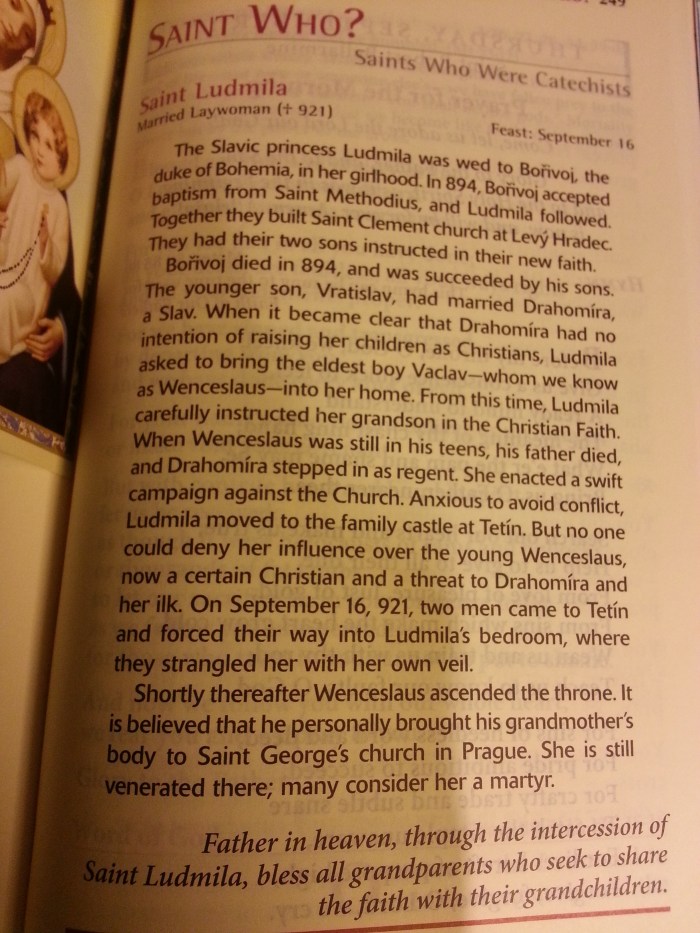
In light of all this, today’s spotlight is perfect. Months ago Amanda emailed me this image from the Magnificat:

ludmila

And said,

I love the story! It seems like more and more of these parent/grandparent saint stories are emerging lately, which makes perfect sense. The saints had to learn from someone!

And I was so struck by that thought — the impact of grandparents on the faith of their grandchildren — that it’s stayed with me all this time. My boys have been very very blessed to have two grandmothers who have contributed in immense ways to their faith formation, as well as a living grandfather (my dad) who’s a great model of Catholic manhood, and a grandfather in heaven (my father-in-law) who I know has been praying for all of us, and who himself was also a great model of Catholic manhood. And of course we can’t forget our dear St. Anne, Grandmother to the Divine, who holds the Sancta Nomina community close.

But — as much as I’m loving the story of St. Ludmila — that name! Oof! So what can we make of Ludmila. I think the secret lies in the second part of her name: Mila’s got a totally current look and sound, and according to behindthename the -mila element of Ludmila means “gracious, dear.” How lovely! Another spelling is Ludmilla, so –> Milla, a la actress Milla Jovovich, whose given name is actually Milica (said MEE-lee-tsah), from the same element that renders -mila in Ludmila; behindthename says Milica was “originally a diminutive of names that began with that element.” Lida is also given as the Czech diminutive of Ludmila, and the comments on behindthename’s entry for Ludmila list Luda, Lulu, Lidka, and Lila as nicknames for it (among other more ethnic options) — Lulu and Lila seem particularly suited to today’s tastes. The DMNES has an entry for Luda, which is from the same word as the Lud- part of Ludmila, and says that Luda can be a pet form of any Slavic name beginning with that element. Could be cute?

I’m also tagging this as a possible Christmas name, since St. Ludmila’s grandson Vaclav/Wenceslaus, who she had so much influence over in terms of teaching the faith, is the King Wenceslaus from the carol “Good King Wenceslaus.” Cool, right?

What do you all think of Ludmila? Would you consider using it as either a first or a middle? Or would Mila/Milla/Lulu/Lila/Luda be more the way you’d go, if you wanted to name a little girl after this saint? Do you know anyone with this name? What do they think of it? Do they go by a nickname?

“Father in heaven, through the intercession of St. Ludmila, bless all grandparents who seek to share the faith with their grandchildren.” ❤


Spotlight on: Mercy names

I’ve gotten a few different requests recently for more info on names connected to Mercy, so I thought it would make a perfect Spotlight post.

This Jubilee Year of Mercy is such a great reason to consider a Mercy name for a baby during it! There’s also the Divine Mercy connection, which, in my mind, includes a connection to both St. Faustina and Pope St. John Paul the Great (I really like typing out his full title. So cool), and there’s Our Lady of Mercy/Mercies. I love them all!

First, of course, is Mercy itself. I love the name Mercy. I’ve seen it used as a middle name, which is a perfect spot for a name that might feel a little too adventurous for one’s style, but I love it as a first name too — I think it holds its own nicely with Grace, Faith, Hope, Sophia, Felicity — all the virtue-esque names. It could have a Pilgrim/Puritan feel also, with their children named Patience and Chastity and Temperance, but that’s not a terrible thing either in my opinion. A pretty variant is Mercia.

Other versions of Mercy that might appeal include:

Mercedes
I love the name Mercedes. I did a mini spotlight here, really just pointing you to a great post by Laura Wattenberg (the Baby Name Wizard herself) on “how such a devout Catholic name became a car brand.” I loved hearing it in Jim Caviezel’s The Count of Monte Cristo, and that movie made it seem do-able to me for non-Spanish families (the characters were French). I’ve also gotten swoony over the idea of Sadie as a nickname (could also be spelled Cedy? I’ve also seen Cedes), and Merche is a traditional Spanish nickname for it; Mercy also certainly works. I’ve seen the combo Maria Mercedes, which is such a heavy hitting name and really emphasizes the Marian aspect.

Clement/Clementine
Clement means “merciful” or “gentle” (think: clemency), so any of the Clement names could work if you’re going for a merciful meaning. I’ve considered Clement for my own boys (just can’t get my hubs on board!), and Clementine is such a great name for a girl (I love the nickname Clemmie, and Emmy and Minnie are also possibilities). I don’t mind the folk song reference either.

Piedad
The meanings of the Spanish Piedad can include “mercy” or “pity.” Piedad is inspired by the Marian title Nuestro Señora de la Piedad (Our Lady of Pity). You can see the connection between “pity” and “mercy” when you think of the phrase “have pity on me” — it’s similar to “have mercy on me.”


Behind the Name offered a bunch of other names that have “mercy” in their meaning, but they were so unfamiliar to me I thought I’d just list them and you can check them out if you’d like: Armo, Chesed, Chifundo, Ebele, Eir, Eskarne, Hanan, Remiel (this is said to be a name of one of the seven archangels according to the apocryphal Book of Enoch. I’d be careful with this, as the Church has not included this name in its list of Archangels’ names).

What do you think of Mercy or the other Mercy-meaning names? Would you consider using them for your child, or have you? Do you know any little ones with any of these names?

Spotlight on: Philomena

This was yet another reader request, and I’m really glad for it, because Philomena’s kind of a funny duck.

On the one hand, there aren’t a whole lot of names that are exclusively Catholic. I mean, I claim lots of names as ours, for impeccable Catholicky Catholic reasons, but that doesn’t mean the rest of the world agrees. But when it comes to Philomena, I think the whole world *does* agree: it’s Catholic. Catholicky Catholic. Oozing Catholic cachet. Do you agree?

The funny part is, though St. Philomena is the source of our love and devotion for this most Catholic of names, she’s no longer on the liturgical calendar, having been removed in 1961 at the directive of Pope Paul VI because of lack of historical evidence.

Is this news to any of you? Because it was to me when I first found out from the mama of this consultation a year ago. Up until I then, I was blissfully ignorant, and from what I can tell, much (most?) of the Catholic world is as well.

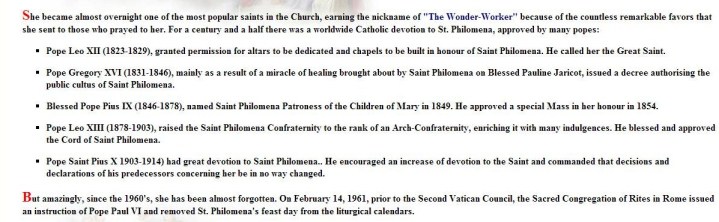
So this is the story, according to this site: In 1802 a tomb was discovered with an inscription that could say “Pax Tecum Filumena” if the words were reorganized, and inside was the skeleton of a 14-year-old girl and a vial of her dried blood. Then:

philomena

I don’t think “since the 1960’s, she has been almost forgotten” is totally accurate, both because I know there are people still bestowing her name on their children, and because of the laity perhaps not being totally clear on what exactly the Church was saying.

From what I can tell, the Church isn’t saying she’s not a saint. This article made a good argument (though based on research that the author doesn’t link to so I can’t verify):

Now, a question that must be addressed in this essay is what the Sacred Congregation of Rites said in regard to Saint Philomena. They removed the feast of Saint Philomena from the calendar based on the lack of historical evidence for her existence. It is very important to note at this point that the Congregation of Rites did not have any ecclesiastical power of any kind. It was only a “liturgical directive”. This directive however left many people confused, and rightfully so. In fact, it left bishops concerned too. Bishop Sebastião Fernandes of Mysore, India, whose cathedral was consecrated in Philomena’s honor, sent a letter to Pope Paul VI in 1964. This correspondence was sent to Mugnano by Bishop Fernandes as follows:

“What must I do for the people in my diocese who are greatly troubled by the decree of the Sacred Congregation regarding St. Philomena?” Paul VI responded, “Do not let it disturb you and do not disturb your people; let devotion to St. Philomena continue as before” (proseguiva come prima)[vi].

These words should be a comfort to those who have faith in the intercession of Saint Philomena, and reinforce the notion that devotion to her has never been officially abolished or suppressed.”

I love what now Bl. Paul VI’s response was! I also love this from that same site:

We have the bones of a young girl, we have a grave that shows the marks of martyrdom, and we have more approved miracles coming from the intercession of this saint than most canonized saints of our times. What does it matter if her original name was Philomena or not? Does it matter whether or not we have no historical documents to prove her existence? No! We have papal approval, and we have miracles. The only way to deny the existence of Saint Philomena is to deny that the miracles which catapulted her to public veneration just 35 years after her buiral discovery in Rome. I assure you, venerating Saint Philomena will be most providential for your soul, for she is powerful with God. Saint Philomena, pray for us! For the glory of God, and the salvation of souls, Amen.”

I like how he says, “What does it matter if her original name was Philomena or not?” I’ve often had the same thought about Sts. Joachim and Anne — we get their names from the Protoevangelium of James, which is not canonical, so there’s a chance those aren’t the names of Mary’s parents, but so what? If they’re not, we have no others to put in their place, and Mary DID have parents, so why not remember them as Joachim and Anne? When we think of their names, we’re thinking of them, you know? This site gives some more really good info, including:

[To St. Pio] St. Philomena was the “Princess of Heaven”. After the liturgical reform of 1961, Father Pio used to imperatively reply to whoever dared to doubt the existence of the Saint: “for the love of God! It might well be that her name is not Philomena, but this Saint has performed many miracles and it is not the name that did them.” This is the wisest reply: who wants to understand, will understand!

Speaking of whether Philomena was actually the girl’s name or not, the name itself has a beautiful meaning. The site I just cited says, “The name Philomena (fee-lo-MAY-nah) is of Latin origin. The inscription on the original loculus tiles, is Filumena. The word filia is Latin for daughter. The word, lumena, is Latin for, light, lamp, lantern; light of day; the eye; clearness; understanding,” while Behind the Name says, “From Greek φιλος (philos) “friend, lover” and μενος (menos) “mind, purpose, strength, courage” … [Filumena] may have in fact been a representation of the Greek word φιλομηνη (philomene) meaning “loved”.” So whichever of those is correct, they’re all beautiful meanings for a little girl and easily full of faith significance if you so desire.

St. Philomena certainly has a history of love in the Church, by Popes and Saints even, and with the name having the Catholic cachet it has, I still think it’s definitely a beautiful name for a Catholic family to consider. Do you agree?

There are the spellings Philomena (English, German, Greek) and Filomena (Italian, Spanish, Portuguese, Dutch), and I myself go back and forth as to which spelling I prefer. There are also loads of nickname options, which I’ve mentioned before: Fia, Fila, Fina, Finn, Finna, Lola, MenaMinnie, Pia, Pim, Pina, and Pippa. Each one so darling!

I’d love to know you what you all know about St. Philomena! Especially if you have any further light to shine on the subject from sources that aren’t critical of various Popes and the Church (I found too many of those when I was doing this research).

And tell me also your thoughts on the name — would you/have you considered Ph/Filomena for a daughter? Which spelling do you prefer? Do you know any Philomenas? Do they like their name? Do they go by a nickname?

Spotlight on: Joan

One of you recently requested a spotlight on Joan and I’d been thinking about it and looking up bits and pieces here and there and then I read this on the DMNES blog:

Joan: Many people may not realize that this is in fact a Biblical name, the name of a woman healed by Jesus and who later accompanied him as a disciple. She was later venerated as a saint, but it was the use of this name by many medieval queens, in addition to the “Maid of Orleans”, Joan of Arc, that helped the name maintain its place as one of the most popular women’s names throughout history.” (emphasis mine)

And knew it was time for the spotlight. 🙂

So Joan is a feminine form of John, which is a great way to start — any of the Sts. John could be honored with a little Joan. But there are loads of amazing Joans (in various forms — I’ll get to that in a minute) that are great patrons for a little girl.

First off, the biblical Joan mentioned above is, I believe, the woman whose name is usually given as Joanna; she’s mentioned briefly in Luke 8:3 as one of the women who accompanied Jesus as He “went on through cities and villages, preaching bringing the good news of the kingdom of God” (Lk 8:1):

And the Twelve were with him, and also some women who had been healed of evil spirits and infirmities: Mary, called Magdalene, from whom seven demons had gone out, and Joanna, the wife of Chuza, Herod’s steward, and Susanna, and many others, who provided for them out of their means.” (Lk 8:1-3)

The footnote in my Bible (Ignatius Catholic Study Bible, Second Edition RSV) is particularly awesome regarding those verses (Lk 8:1-3):

Jesus’ urgent mission left no time for him and the disciples to settle into a trade. Several women thus accompanied them to offer provisions and financial assistance. This challenged Jewish custom, which discouraged men from associating with women in public (Jn 4:27).”

(That reference to Jn 4:27 is this: “Just then his disciples came. They marveled that he was talking with a woman …”) (The woman was the Samaritan woman; interesting that they marveled that He was talking with a woman, rather than with a Samaritan.)

Then of course there’s St. Joan of Arc — a totally awesome warrior woman! She’s also known as Jean/Jeanne/Jehanne.  A personal favorite of mine is the mother of St. Dominic, known variously as Bl. Joan/Jane/Joanna/Juana of Aza. There are a whole bunch of others (lots of Sts. John included in that list as well).

Speaking of variants, these are all listed in the DMNES entry on Joan — they all had medieval use (I’m not listing all the variants — there are tons! But these were either my favorites or the ones I was most surprised by):

Genne, Genet
Ione
Jana
Jane, Jayn, Jayne, Jeyne, Jaen, Jaine
Janet
Janne
Jean, Jeanne, Geane
Jehanne, Jehenne, Jehanette
Jenna
Jenne
Joana, Joanna, Johanna
Joane, Jone
Johanetta
Jonet
Juana, Juanita
Vana
Vannella
Zoana, Zoanna

Awesome list, right? So many great ways to honor a Joan! Re: Ione, I’d recently come across this book, which lists several places in literature (like Shakespeare) where Ione was used interchangeably with Joan (read the bottom of p. 156 and top of p. 157 — the link takes you right to it).

As for Joan itself, I’ve always thought the nickname Joanie is sweet, and Jo/Joey could also work; I’ve also seen Nonie. In this case, of course, the nicknames would be more affectionate or spunky rather than true diminutives or need for something shorter — you can’t get much shorter than the one-syllable Joan! There are a million nicknames for its variants too (Jane et al.), but I won’t get into them here.

What do you all think of Joan? Would you consider it for your daughter, or have you? Do you prefer one of its variants? Do you know any Joans (big or little), and if so, what do they think of their name? Do they go by nicknames?