This was yet another reader request, and I’m really glad for it, because Philomena’s kind of a funny duck.
On the one hand, there aren’t a whole lot of names that are exclusively Catholic. I mean, I claim lots of names as ours, for impeccable Catholicky Catholic reasons, but that doesn’t mean the rest of the world agrees. But when it comes to Philomena, I think the whole world *does* agree: it’s Catholic. Catholicky Catholic. Oozing Catholic cachet. Do you agree?
The funny part is, though St. Philomena is the source of our love and devotion for this most Catholic of names, she’s no longer on the liturgical calendar, having been removed in 1961 at the directive of Pope Paul VI because of lack of historical evidence.
Is this news to any of you? Because it was to me when I first found out from the mama of this consultation a year ago. Up until I then, I was blissfully ignorant, and from what I can tell, much (most?) of the Catholic world is as well.
So this is the story, according to this site: In 1802 a tomb was discovered with an inscription that could say “Pax Tecum Filumena” if the words were reorganized, and inside was the skeleton of a 14-year-old girl and a vial of her dried blood. Then:
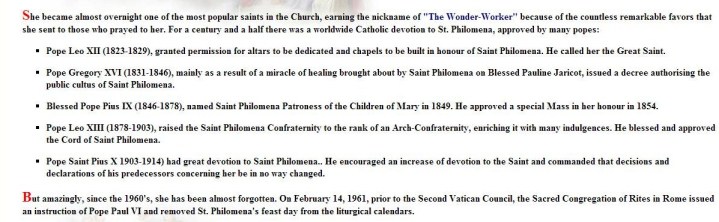
I don’t think “since the 1960’s, she has been almost forgotten” is totally accurate, both because I know there are people still bestowing her name on their children, and because of the laity perhaps not being totally clear on what exactly the Church was saying.
From what I can tell, the Church isn’t saying she’s not a saint. This article made a good argument (though based on research that the author doesn’t link to so I can’t verify):
“Now, a question that must be addressed in this essay is what the Sacred Congregation of Rites said in regard to Saint Philomena. They removed the feast of Saint Philomena from the calendar based on the lack of historical evidence for her existence. It is very important to note at this point that the Congregation of Rites did not have any ecclesiastical power of any kind. It was only a “liturgical directive”. This directive however left many people confused, and rightfully so. In fact, it left bishops concerned too. Bishop Sebastião Fernandes of Mysore, India, whose cathedral was consecrated in Philomena’s honor, sent a letter to Pope Paul VI in 1964. This correspondence was sent to Mugnano by Bishop Fernandes as follows:
“What must I do for the people in my diocese who are greatly troubled by the decree of the Sacred Congregation regarding St. Philomena?” Paul VI responded, “Do not let it disturb you and do not disturb your people; let devotion to St. Philomena continue as before” (proseguiva come prima)[vi].
These words should be a comfort to those who have faith in the intercession of Saint Philomena, and reinforce the notion that devotion to her has never been officially abolished or suppressed.”
I love what now Bl. Paul VI’s response was! I also love this from that same site:
“We have the bones of a young girl, we have a grave that shows the marks of martyrdom, and we have more approved miracles coming from the intercession of this saint than most canonized saints of our times. What does it matter if her original name was Philomena or not? Does it matter whether or not we have no historical documents to prove her existence? No! We have papal approval, and we have miracles. The only way to deny the existence of Saint Philomena is to deny that the miracles which catapulted her to public veneration just 35 years after her buiral discovery in Rome. I assure you, venerating Saint Philomena will be most providential for your soul, for she is powerful with God. Saint Philomena, pray for us! For the glory of God, and the salvation of souls, Amen.”
I like how he says, “What does it matter if her original name was Philomena or not?” I’ve often had the same thought about Sts. Joachim and Anne — we get their names from the Protoevangelium of James, which is not canonical, so there’s a chance those aren’t the names of Mary’s parents, but so what? If they’re not, we have no others to put in their place, and Mary DID have parents, so why not remember them as Joachim and Anne? When we think of their names, we’re thinking of them, you know? This site gives some more really good info, including:
“[To St. Pio] St. Philomena was the “Princess of Heaven”. After the liturgical reform of 1961, Father Pio used to imperatively reply to whoever dared to doubt the existence of the Saint: “for the love of God! It might well be that her name is not Philomena, but this Saint has performed many miracles and it is not the name that did them.” This is the wisest reply: who wants to understand, will understand!“
Speaking of whether Philomena was actually the girl’s name or not, the name itself has a beautiful meaning. The site I just cited says, “The name Philomena (fee-lo-MAY-nah) is of Latin origin. The inscription on the original loculus tiles, is Filumena. The word filia is Latin for daughter. The word, lumena, is Latin for, light, lamp, lantern; light of day; the eye; clearness; understanding,” while Behind the Name says, “From Greek φιλος (philos) “friend, lover” and μενος (menos) “mind, purpose, strength, courage” … [Filumena] may have in fact been a representation of the Greek word φιλομηνη (philomene) meaning “loved”.” So whichever of those is correct, they’re all beautiful meanings for a little girl and easily full of faith significance if you so desire.
St. Philomena certainly has a history of love in the Church, by Popes and Saints even, and with the name having the Catholic cachet it has, I still think it’s definitely a beautiful name for a Catholic family to consider. Do you agree?
There are the spellings Philomena (English, German, Greek) and Filomena (Italian, Spanish, Portuguese, Dutch), and I myself go back and forth as to which spelling I prefer. There are also loads of nickname options, which I’ve mentioned before: Fia, Fila, Fina, Finn, Finna, Lola, Mena, Minnie, Pia, Pim, Pina, and Pippa. Each one so darling!
I’d love to know you what you all know about St. Philomena! Especially if you have any further light to shine on the subject from sources that aren’t critical of various Popes and the Church (I found too many of those when I was doing this research).
And tell me also your thoughts on the name — would you/have you considered Ph/Filomena for a daughter? Which spelling do you prefer? Do you know any Philomenas? Do they like their name? Do they go by a nickname?




 Sancta Nomina